BRIEF
Create an an engaging and interactive experience with digital, spatial and playful components. Our identified problem area was the pre-concert experience, discovered to be a period of endurance and boredom, as opposed to excitement and anticipation.
DURATION
13 Weeks (Feb - Jun)
TEAM
Myself + 2 Team Members
METHODS + TOOLS
introduction
THE PRE-CONCERT EXPERIENCE
We defined the pre-concert experience as the activities, emotions, and interactions concert-goers engage in before attending a live music event, including:
Preparing and organising travel arrangements and concert outings
Queueing outside the venue
Interacting and socialising with fellow attendees
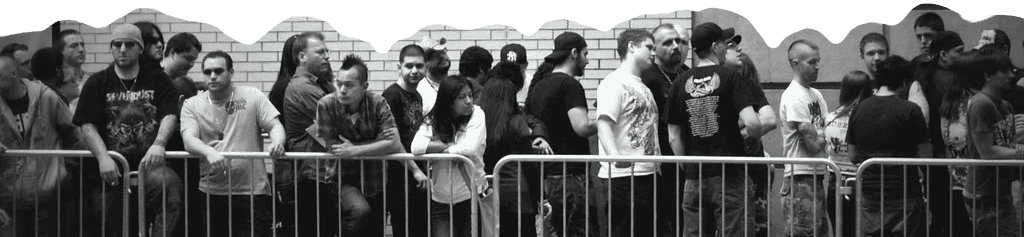
Avid music fans are known for spending a lot of time waiting before a concert to get the best view as possible. However this comes at a psychological cost, as waiting is often perceived as an obstacle (Chebat et. al., 1993). Just as concert-goers feel excited during the main show, why can't they also feel anticipation beforehand?
Here's what we also discovered:
Phones, games or talking with friends are often merely coping mechanisms - they don't spark anticipation or are memorable.
Spaces outside venues lack recreation.
Crowded waiting spaces exacerbates social awkwardness and fears of rejection.
research
PRIMARY RESEARCH
Our secondary research of articles and academic papers (plus our own personal anecdotes) helped us to gain foundational knowledge surrounding the limitations of the pre-concert experience, and what concert-goers do to cope. To gain a deeper understanding, we aimed to assess the pre-concert experiences of people waiting at concert venues first-hand.
Our Research Objectives
We conducted five methods of research to answer these objectives and obtain insights to refine our problem space. Most of these methods were conducted contextually at a venue pre-concert, allowing us to obtain detailed and accurate findings.
Contextual Observations
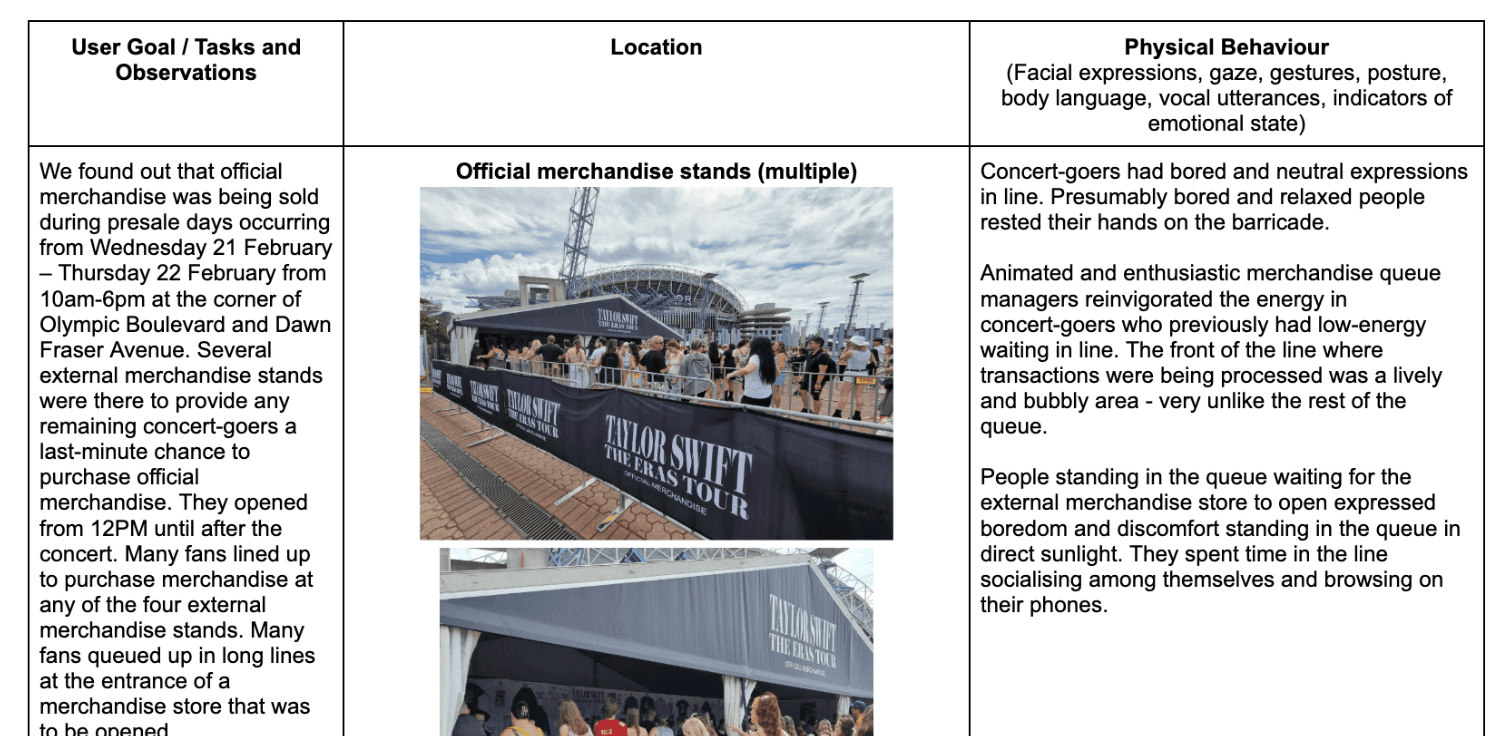
Enabled us to gain a holistic overview of how concert-goers interact and behave in the physical spaces around them. It also helped us to identify problems encountered while waiting at concert venues.
Contextual Inquiries
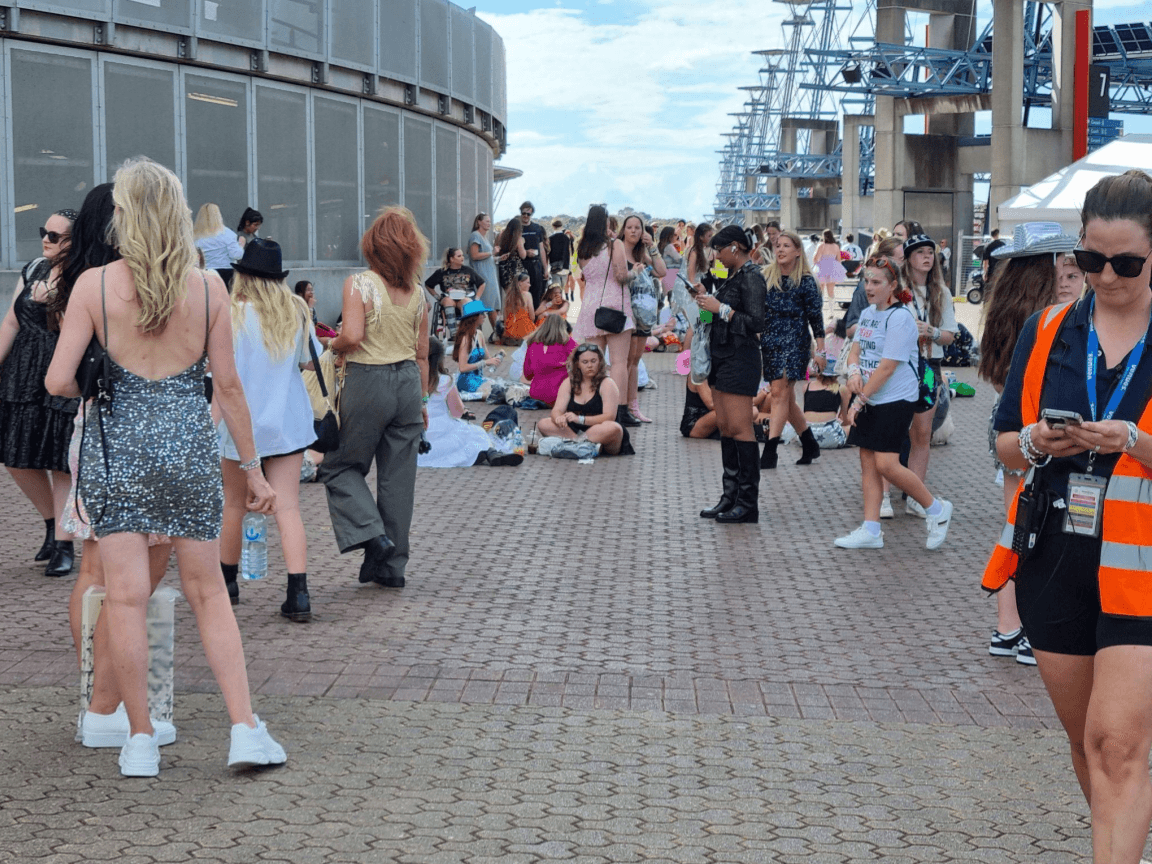
We also conducted short in-situ interviews with 7 participants to gain an in-depth understanding about their experiences and opinions relating to concerts and waiting spaces outside venues.
Mapping Space
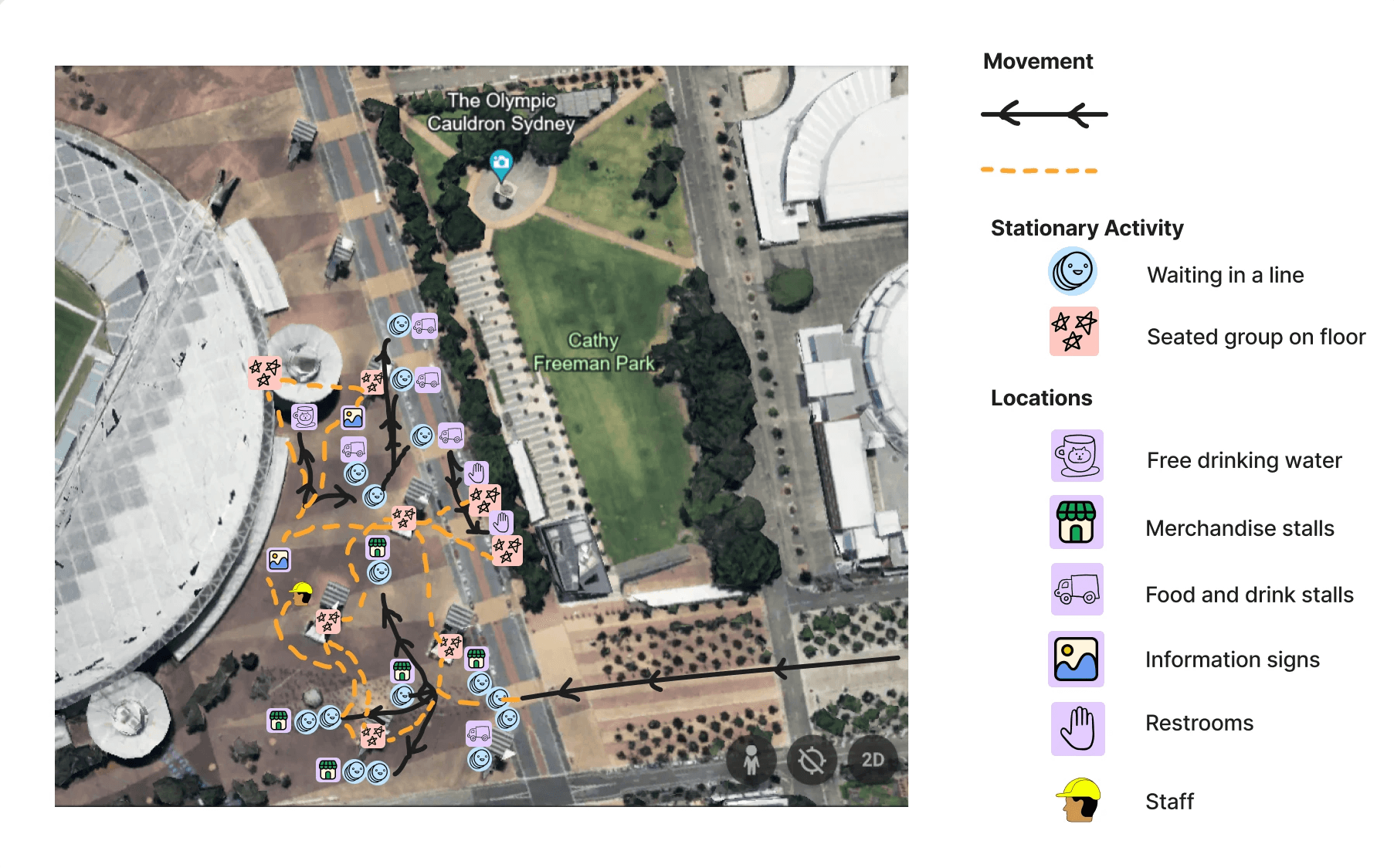
This diagram holistically captured the behaviours of concert-goers and spatial data of the space outside concert venues.
Interviews
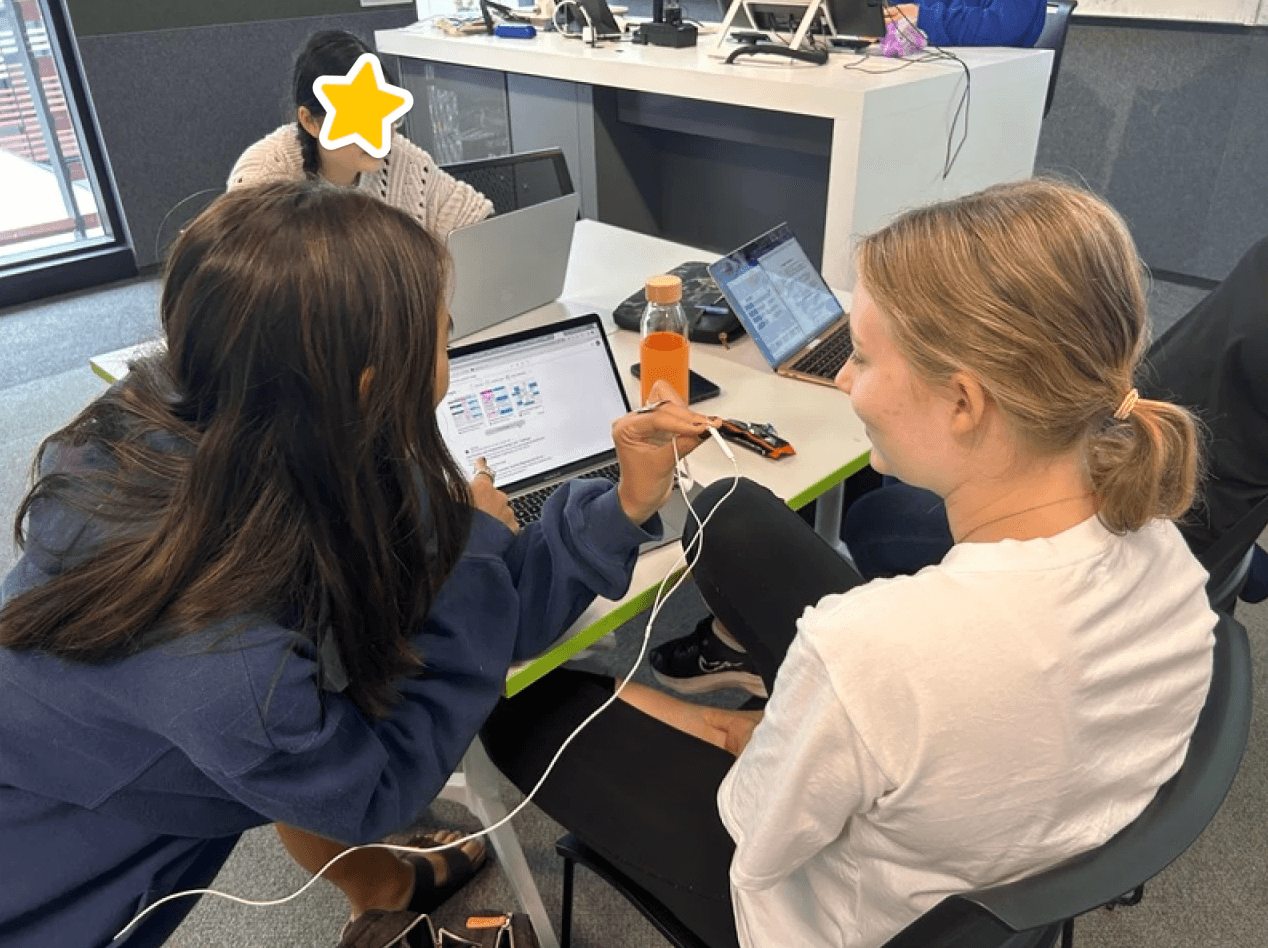
We conducted 15-20 minute semi-structured interviews with 6 participants. We probed survey responses, inquired participants about their concert-going journeys and opinions of pre-concert experiences.
Surveys
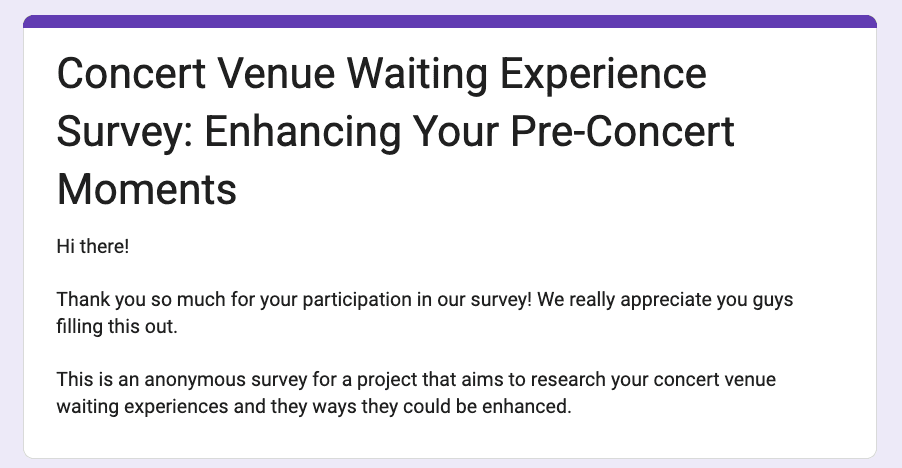
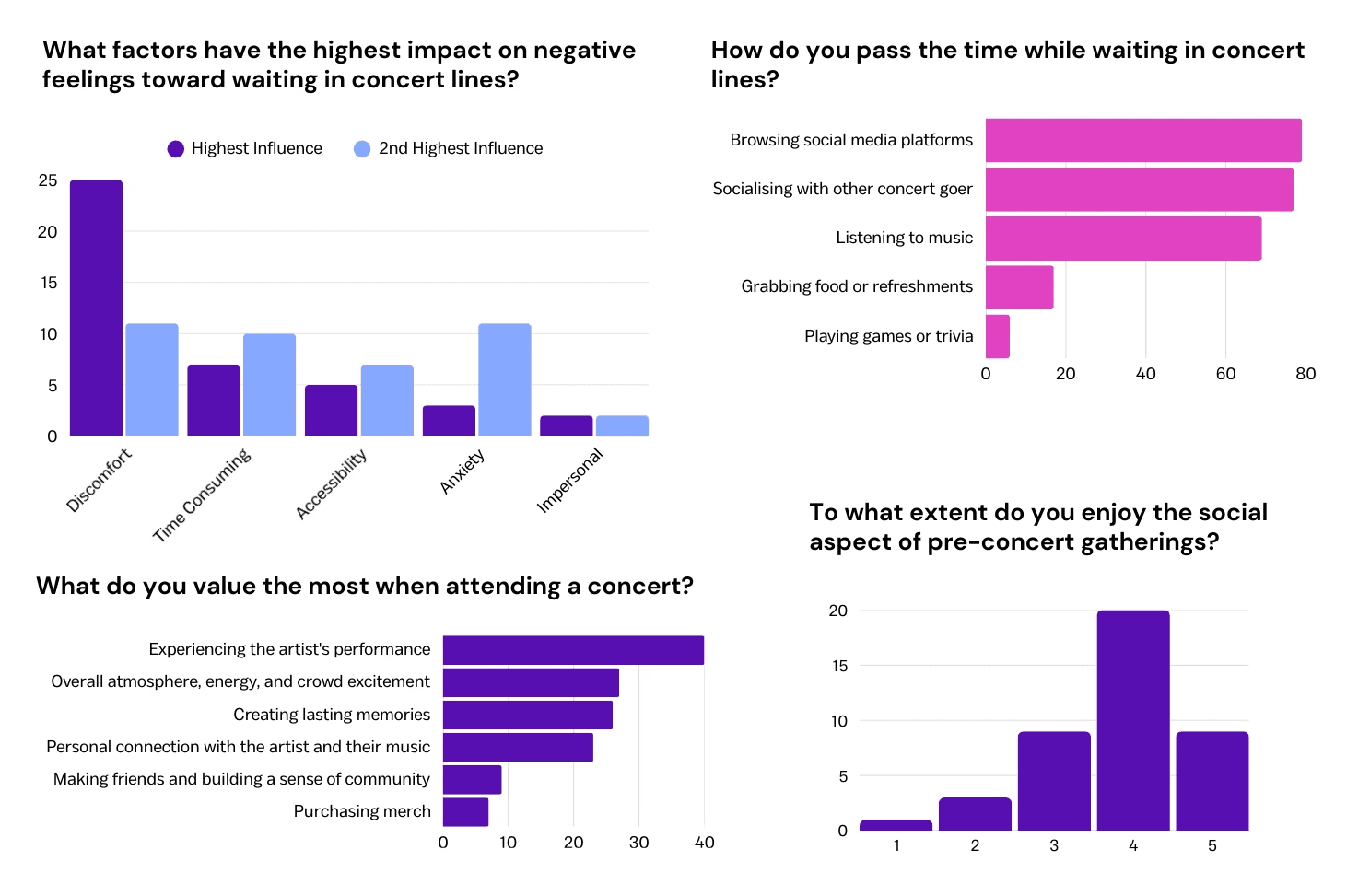
42 responses from concert-goers helped us to identify general trends and generate quantitative and qualitative data of relating to the pre-concert experience.
TRIANGULATION - WHY ALL THESE RESEARCH METHODS?
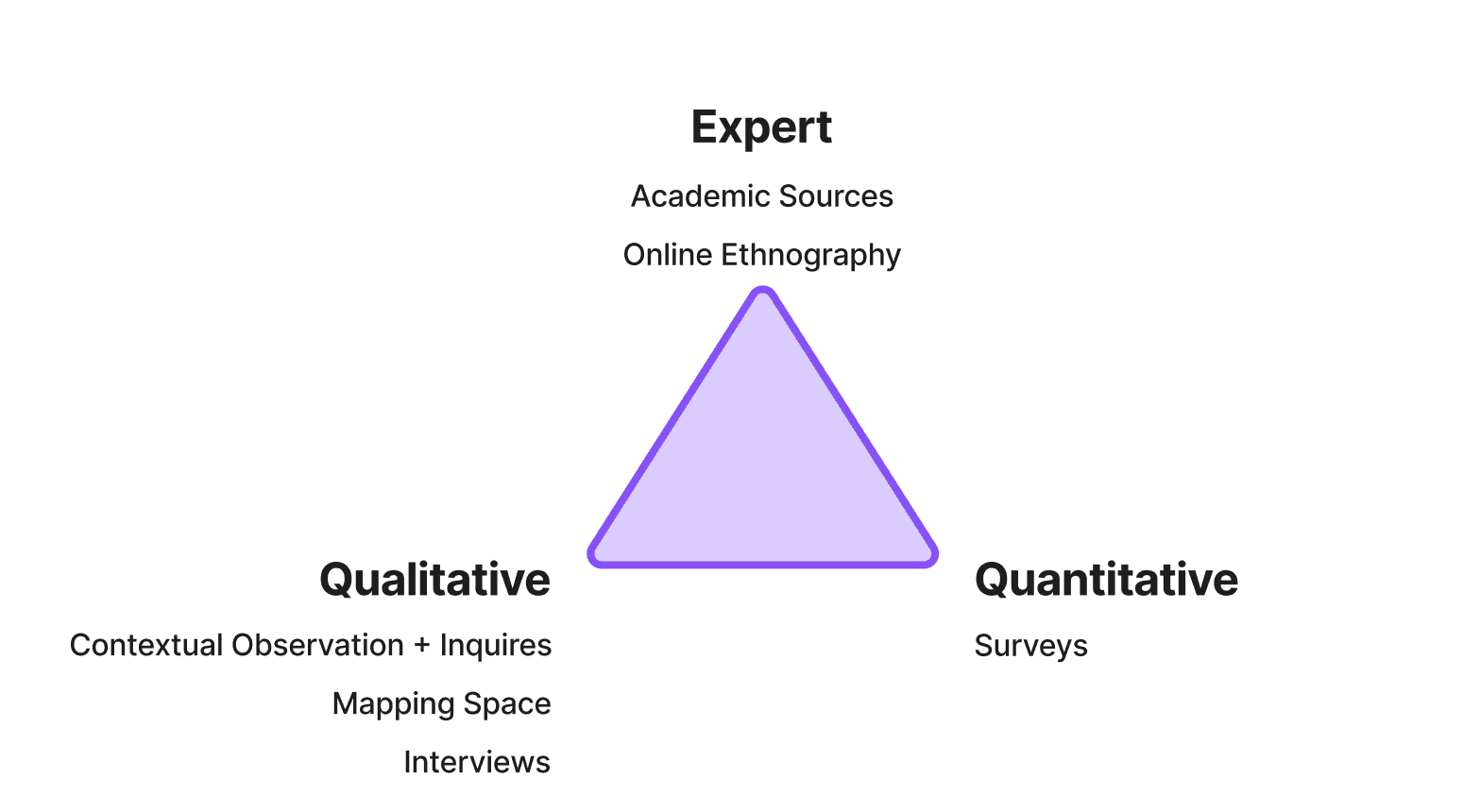
Triangulation of our primary data ensured that the "weaknesses can be compensated for by the strengths of other data, thus increasing the validity and reliability of the results" (Panagiotidi, 2022). Whilst we each had our own experiences going to concerts, it was crucial that we avoided any biases and obtain a more holistic and objective understanding with the five methods.
problem
ANALYSIS
To generate actionable insights, we utilised thematic analysis of data from contextual inquires, observations, interviews and surveys. This method was chosen for its flexibility, accomodating for both qualitative and qualitative data, of which we could identify underlying patterns.
We consolidated over 350 data fragments from our research into a master spreadsheet. We then created and assigned 60 codes, afterwards organised into 12 themes in an affinity diagram.
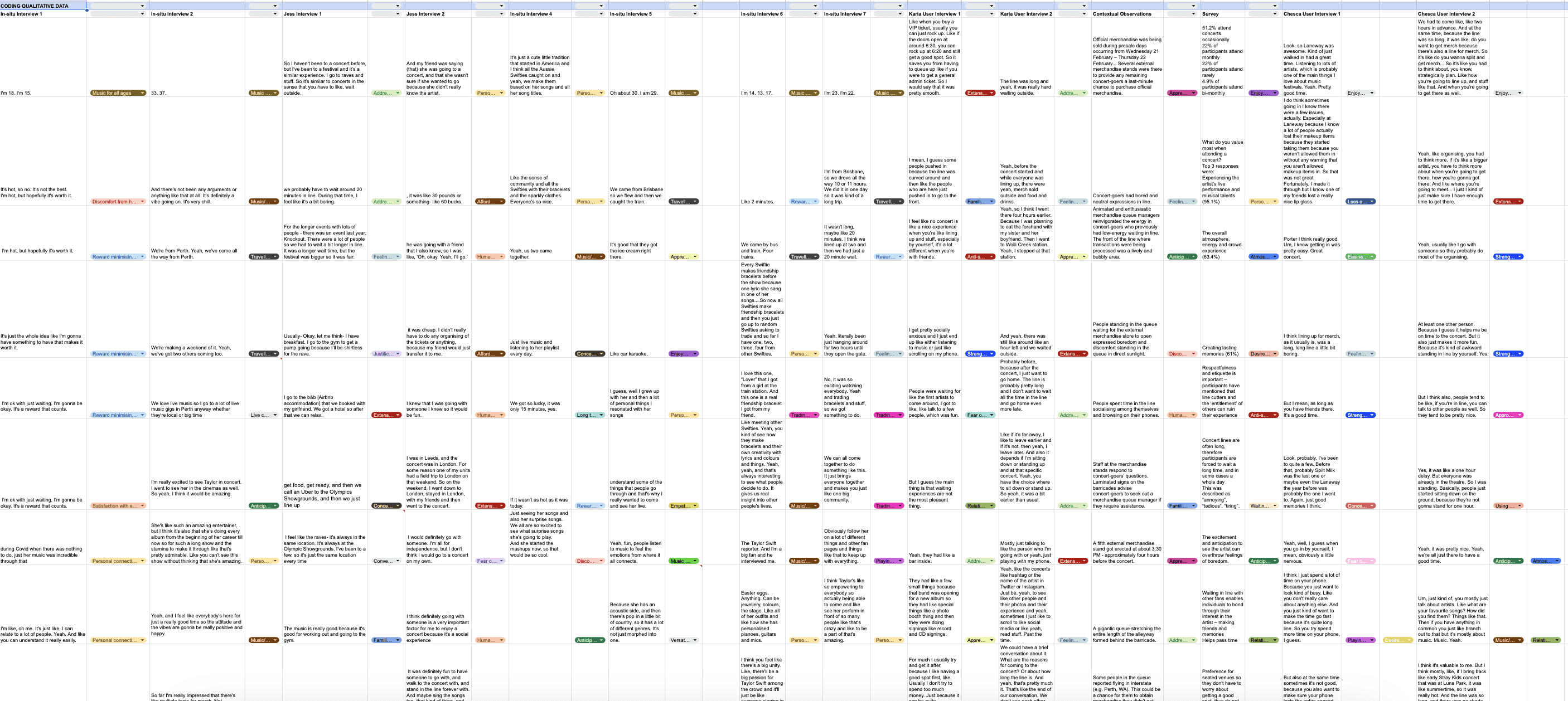
350 data fragments
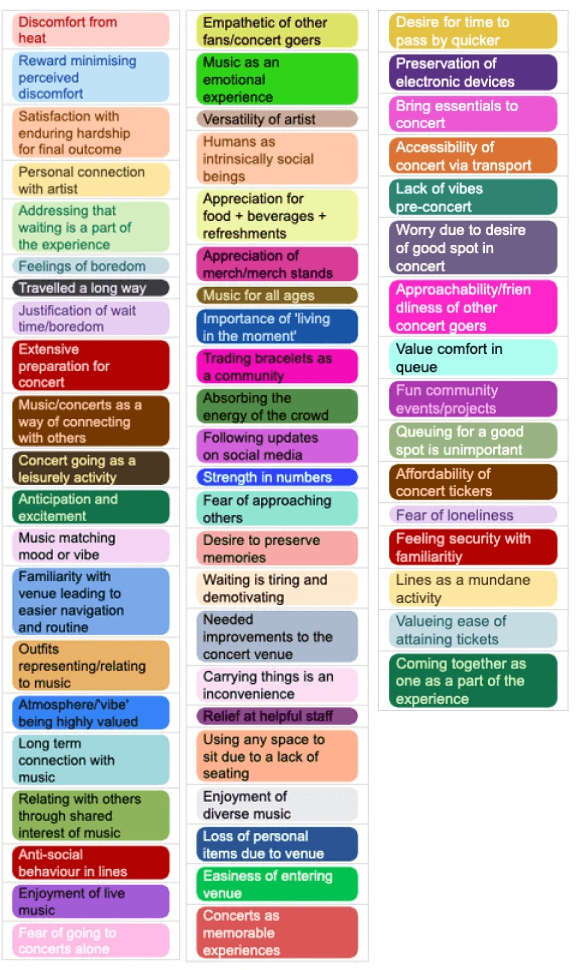
60 codes

Affinity diagram of 12 themes
SYNTHESIS
Grouping our generated themes based on interconnectedness and relevance generated five key insights:
User Topology
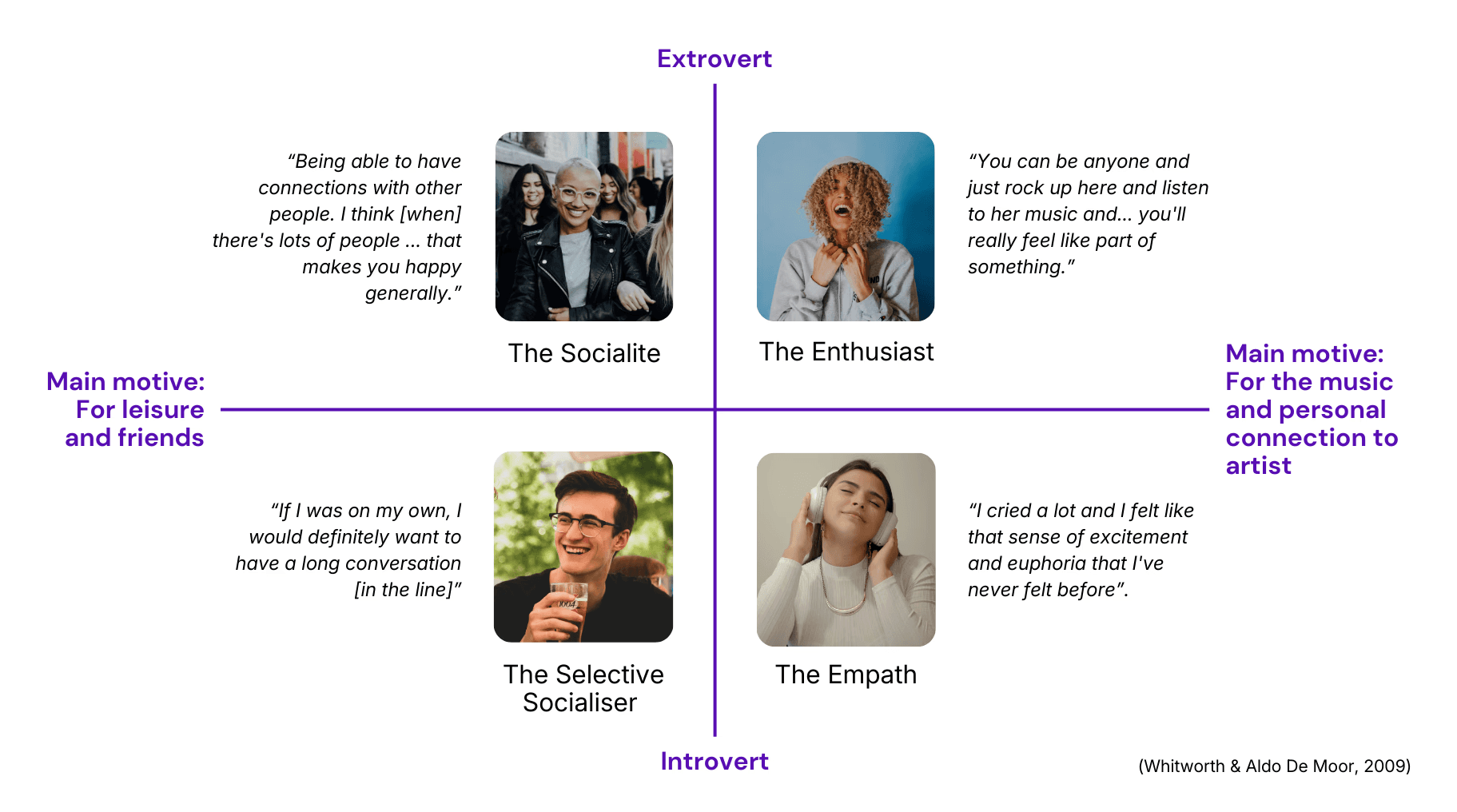
To further extrapolate our generated insights and flesh out the diverse needs and motivations of concert-goers, we created a user topology. This allowed us to accommodate for these various archetypes in our design solution without creating multiple personas.
Meet Kirstin!
According to our user topology, Kirstin is what you would call an "Enthusiast". She thrives on connections with music and other enthusiast fans, however she frustrated by long queues, anti-social behaviour from other concert-goers, and the lack of recreational spaces.
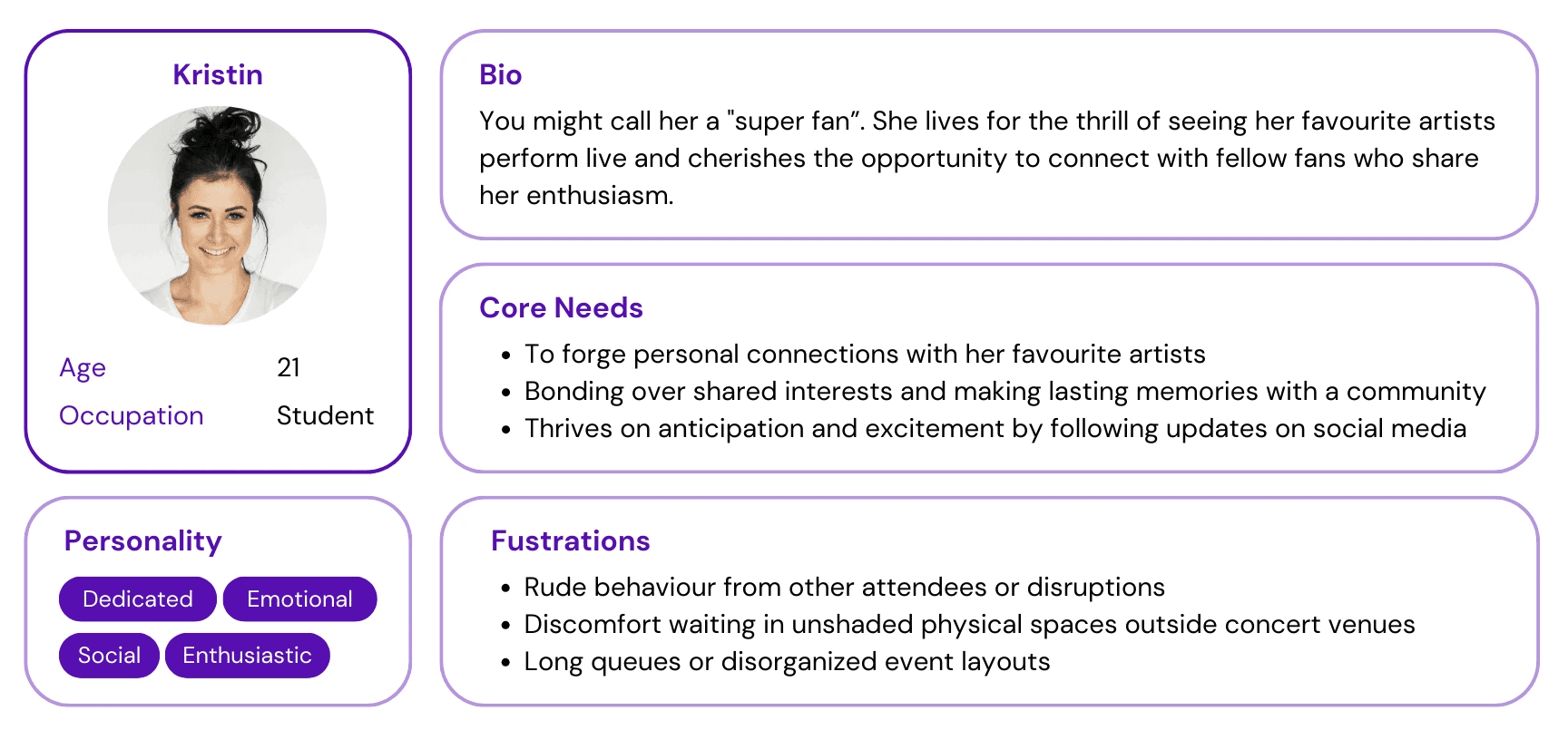
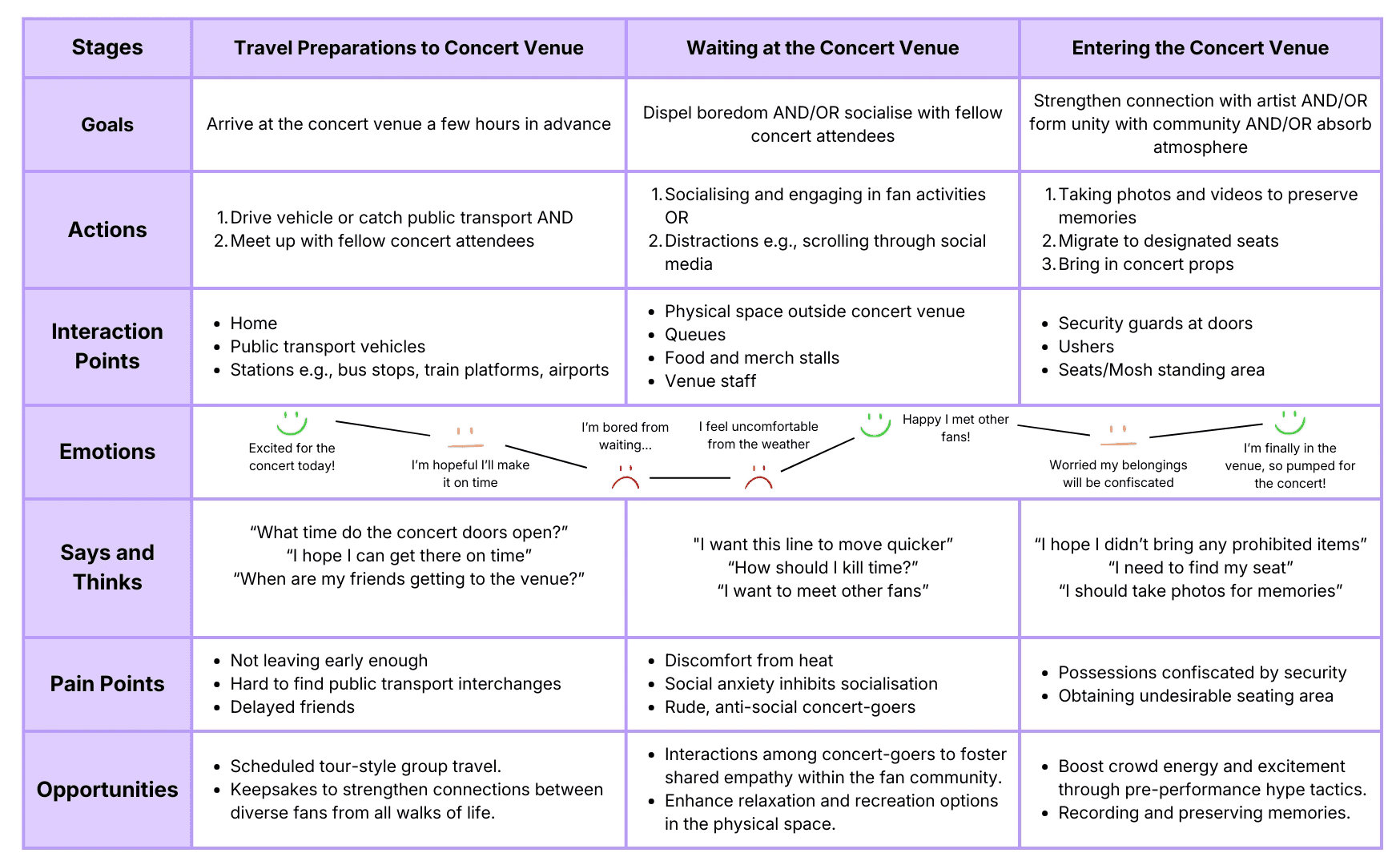
Kirstin's profile and user journey helped us to identify actionable needs that maintains her anticipation and excitement with fellow fans. It also highlighted her low points, presenting us with design opportunities as we move onto the next stages.
REFINED PROBLEM
How Might We…
GENERATING IDEAS
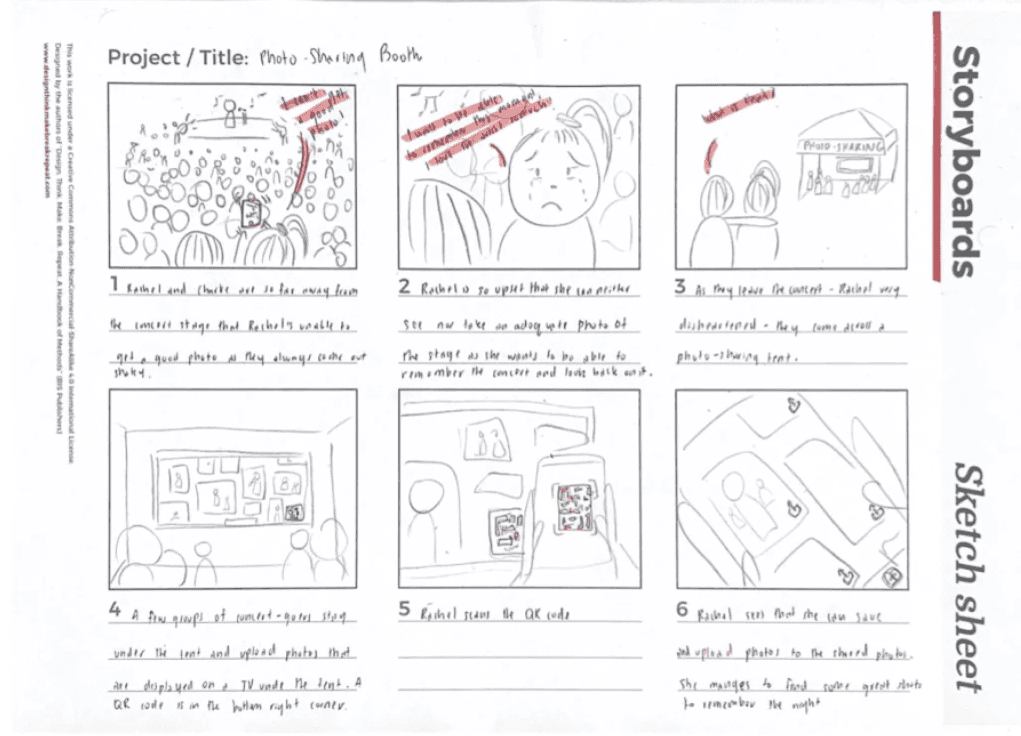
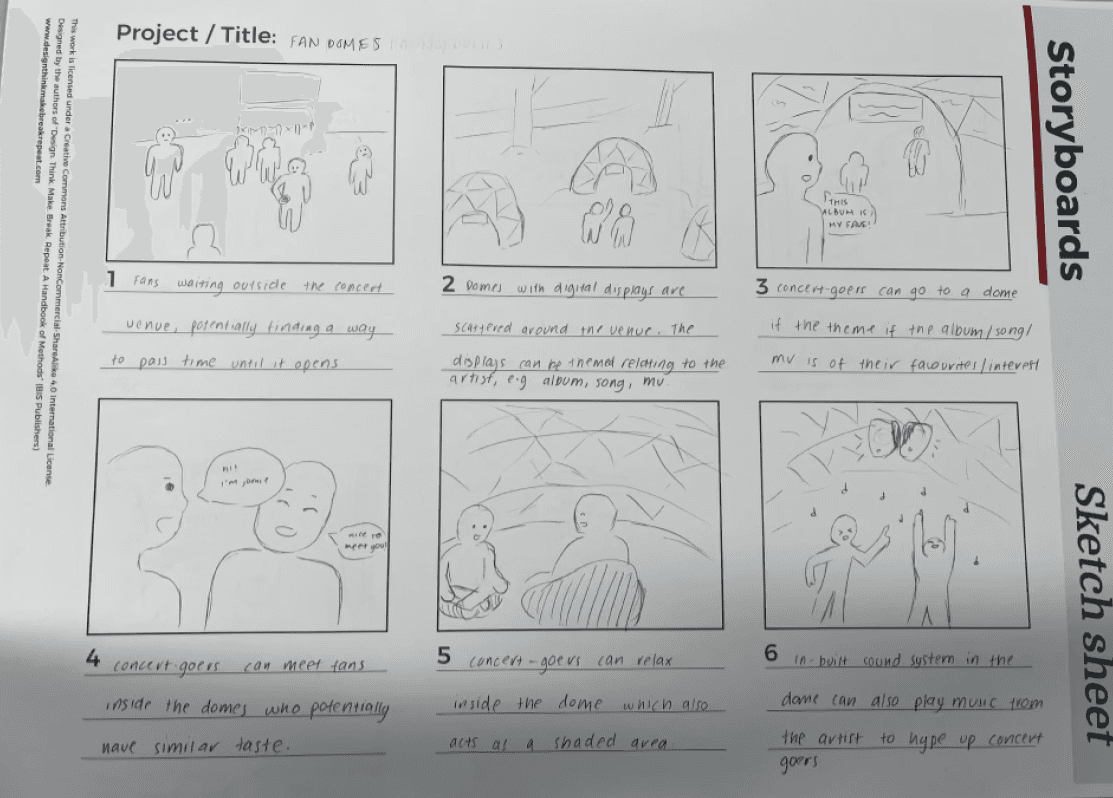
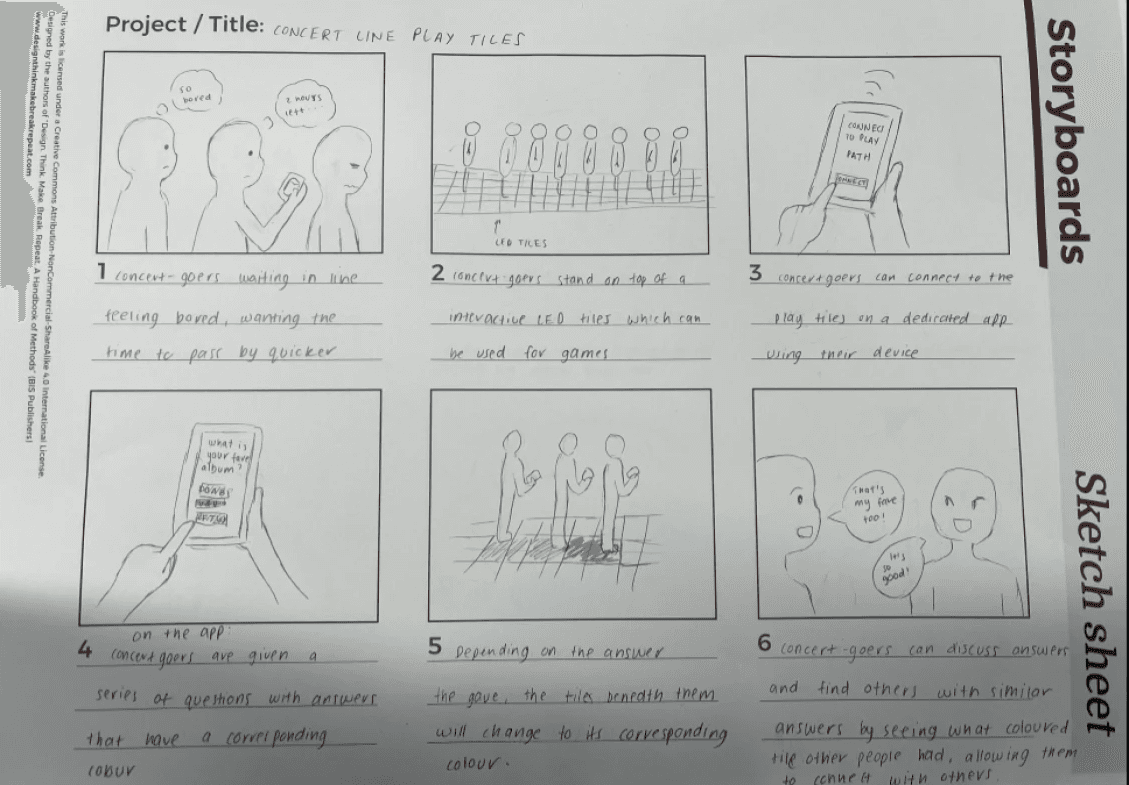
After brainstorming individually, we each created storyboards of our best ideas to help us envision the user journeys and how they would interact with the product.
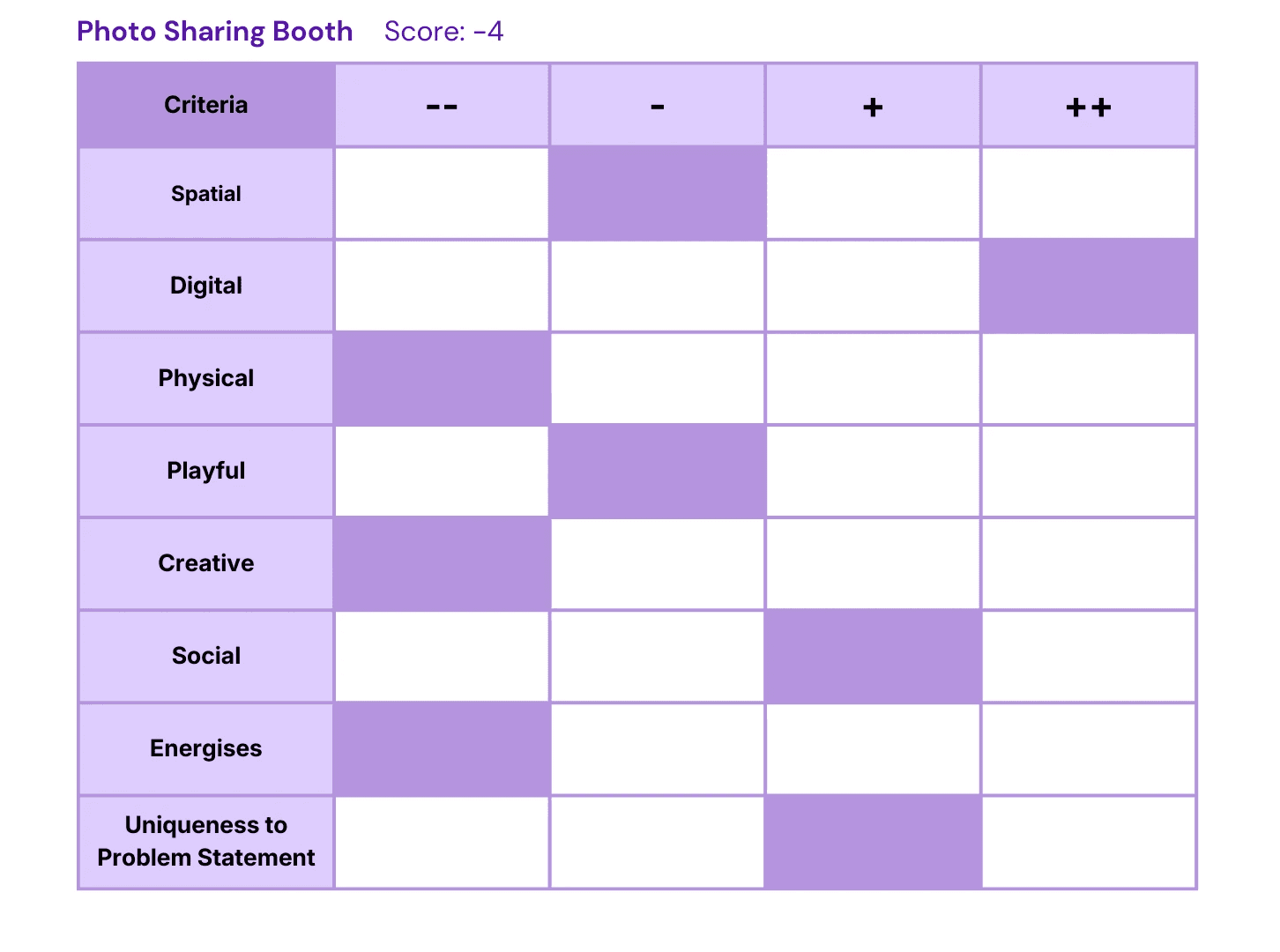
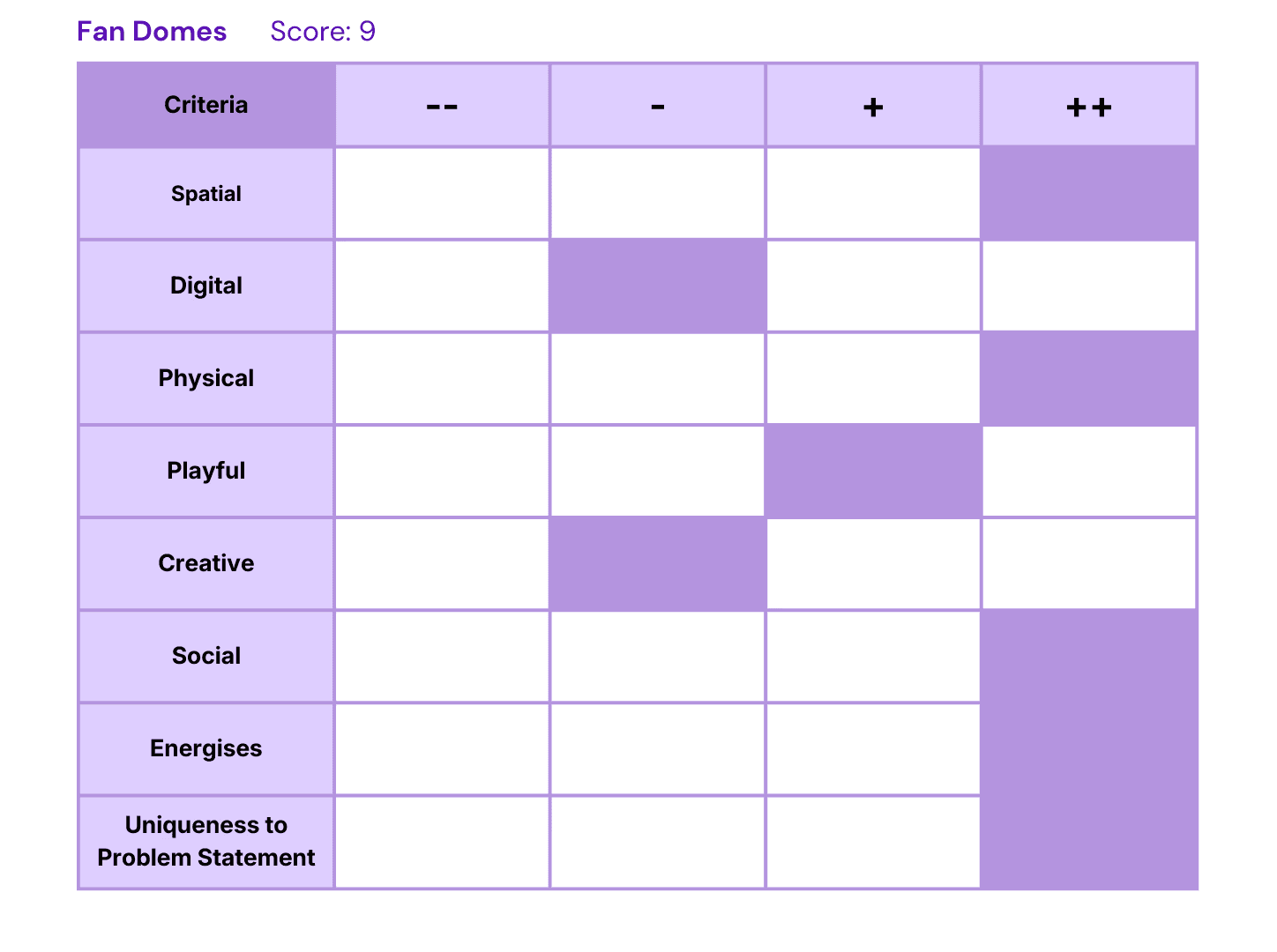
We selected our concept using a decision matrix, consisting of a criteria that aligned with the project brief and our fundamental insights. This ensured that we moved forward with the strongest concept that can address our identified problem.
There were our top 3 concepts:
Photo Sharing Booth
Fan Domes
Concert Line Play Tiles
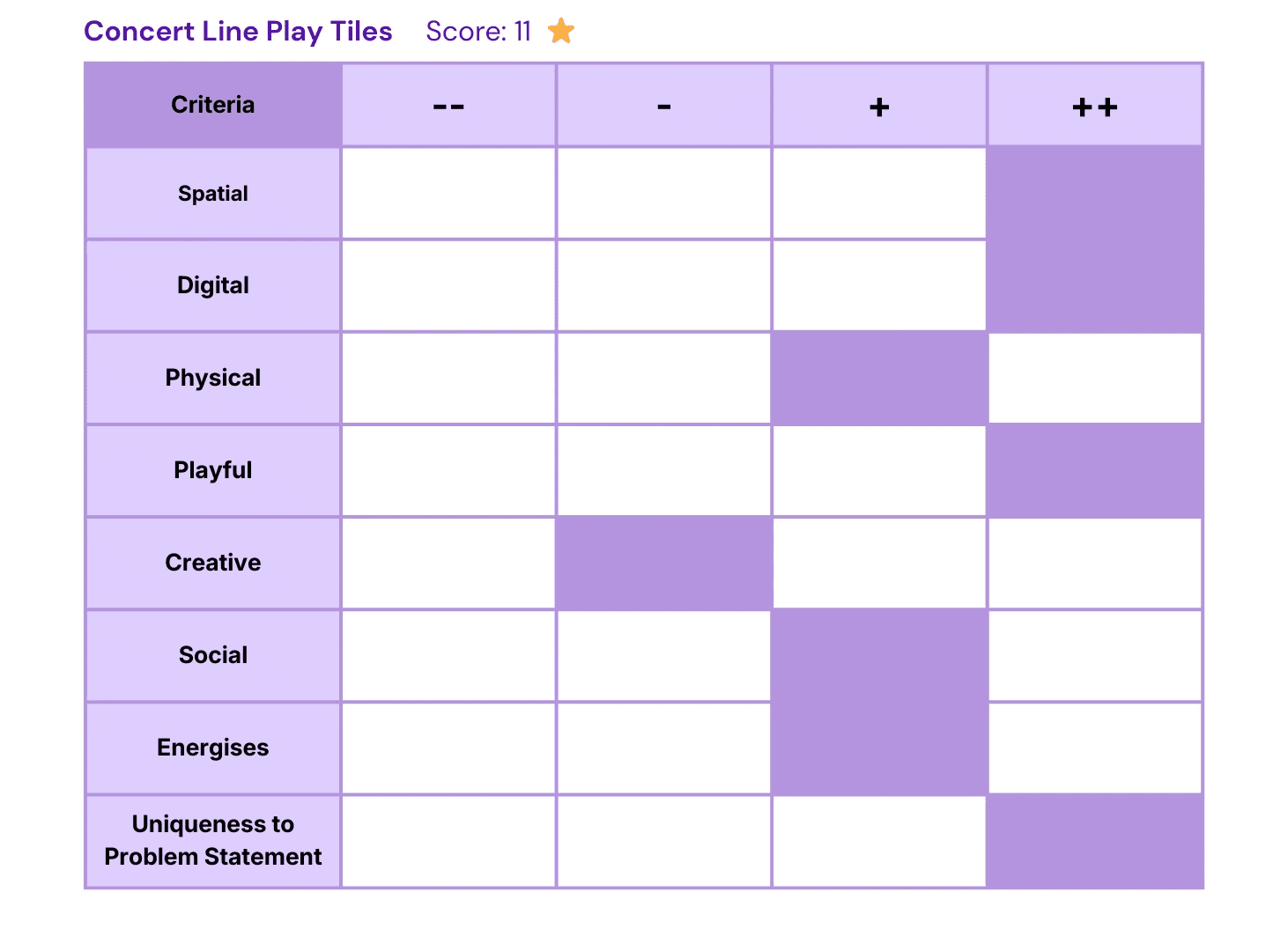
Based on the criteria and scores, we chose to develop "Concert Line Play Tiles" for its practicality in tackling emotional low points at concerts, such as boredom and frustration in long queues.
To summarise the concept, underneath queuing concert-goers are "play tiles" that light up. The experience is supplemented with an app similar to Kahoot, on which they will answer questions related to the performing artist. Based on their answers, the "play tile" beneath will light up with a corresponding colour. Concert-goers can recognise what others answered based on their coloured tile, potentially sparking social interaction.
CONCEPT DEVELOPMENT
Consulting with our tutor revealed three issues…
Iteration 1
For our first iteration, we solved the issue of the required app download, replaced by a light-up wristband with intractable buttons. However it still did not address the two other issues as mentioned above.
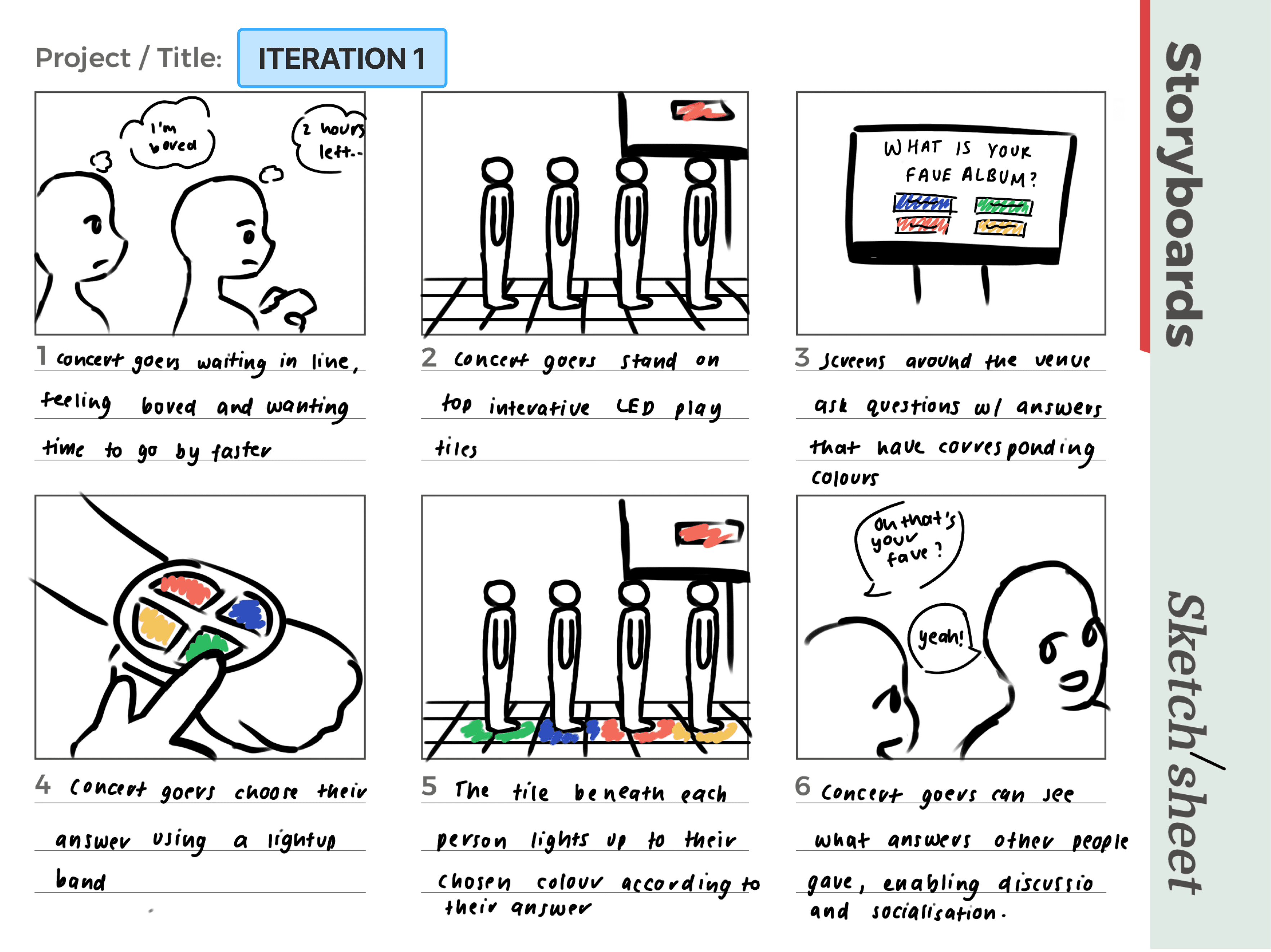
Storyboard of iteration 1
Iteration 2 (Our Final Concept!)
Through research, we discovered that group activities fulfill our need to belong through social interaction. Thus, we chose to integrate a group activity with a shared goal to incentivise user interaction. Our precedent research of "participatory art" revealed installations that blend soundscapes or music and encouraged people to become a part of the creative process.
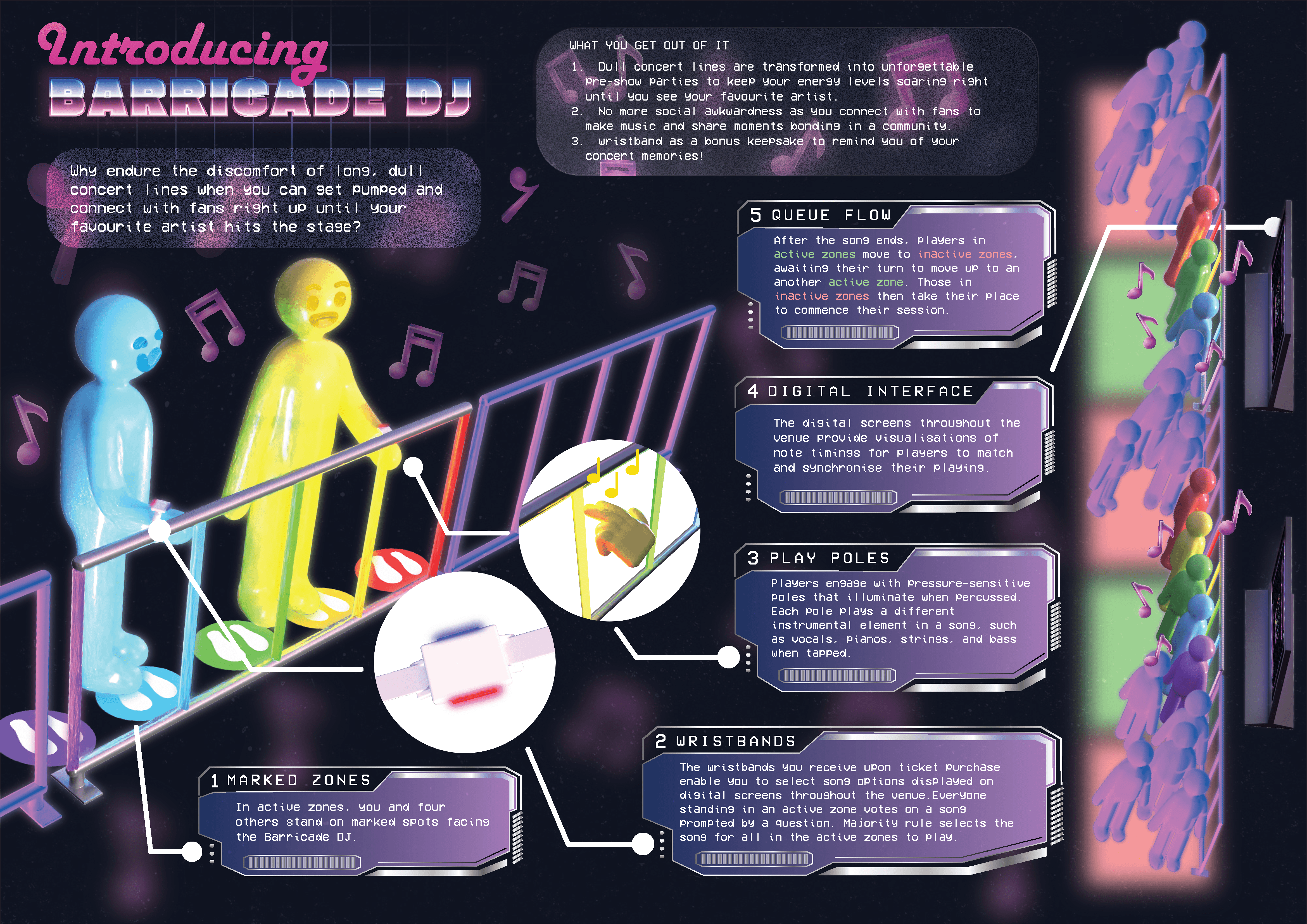
Our discoveries led to Barricade DJ! It combines digital, spatial and playful elements to create a fun and social experience. Together, concert-goers co-create a soundscape that connects them with their favourites artists through music.
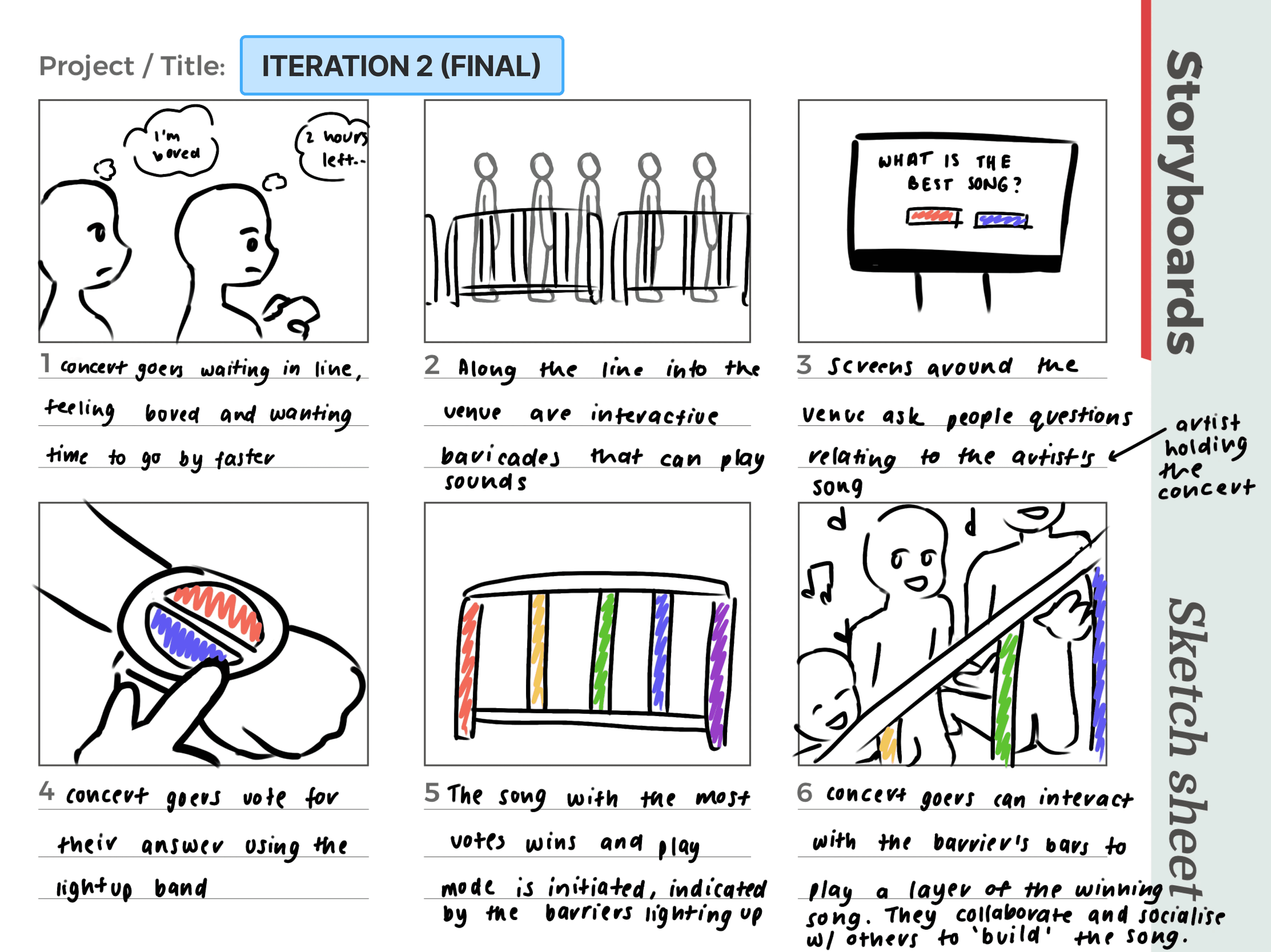
Storyboard of iteration 2
Here's how it addressed the identified issues:
Requirement of downloadable app to participate.
Use of keepsake wristbands to participate. Simplifies steps for users!
Insight 3
Social aspects lack a strong user incentive.
Encouragement of collaboration to create a soundscape.
Insight 4 + 5
Better integration of elements from the environment.
Use of digital screens and interact-able barricades present at venues.
Insight 2
All of these revisions also helped to address Insight 1, as strengthening connections between fans and the artist through music helps to maintain anticipation and excitement.
BEFORE WE BEGIN PROTOTYPING…
We sent out a "Concept Test" survey to gauge whether concert-goers understand how Barricade DJ works, and their opinions + suggestions regarding its usage. While most participants understood the concept, we received valuable forethought and adjusted some logistics:
Most responses stated that crowds would be unmanageable.
Flexibility of 2-5 players at time which is more suitable for crowd flow.
Sound might be hard to hear within the crowd.
Inclusion of speakers for prototype.
prototype
OUR PROCESS
LOW-FIDELITY
Our main focus at this stage was developing each component of Barricade DJ with consideration of how they would work in tandem with each other.
Light Bands
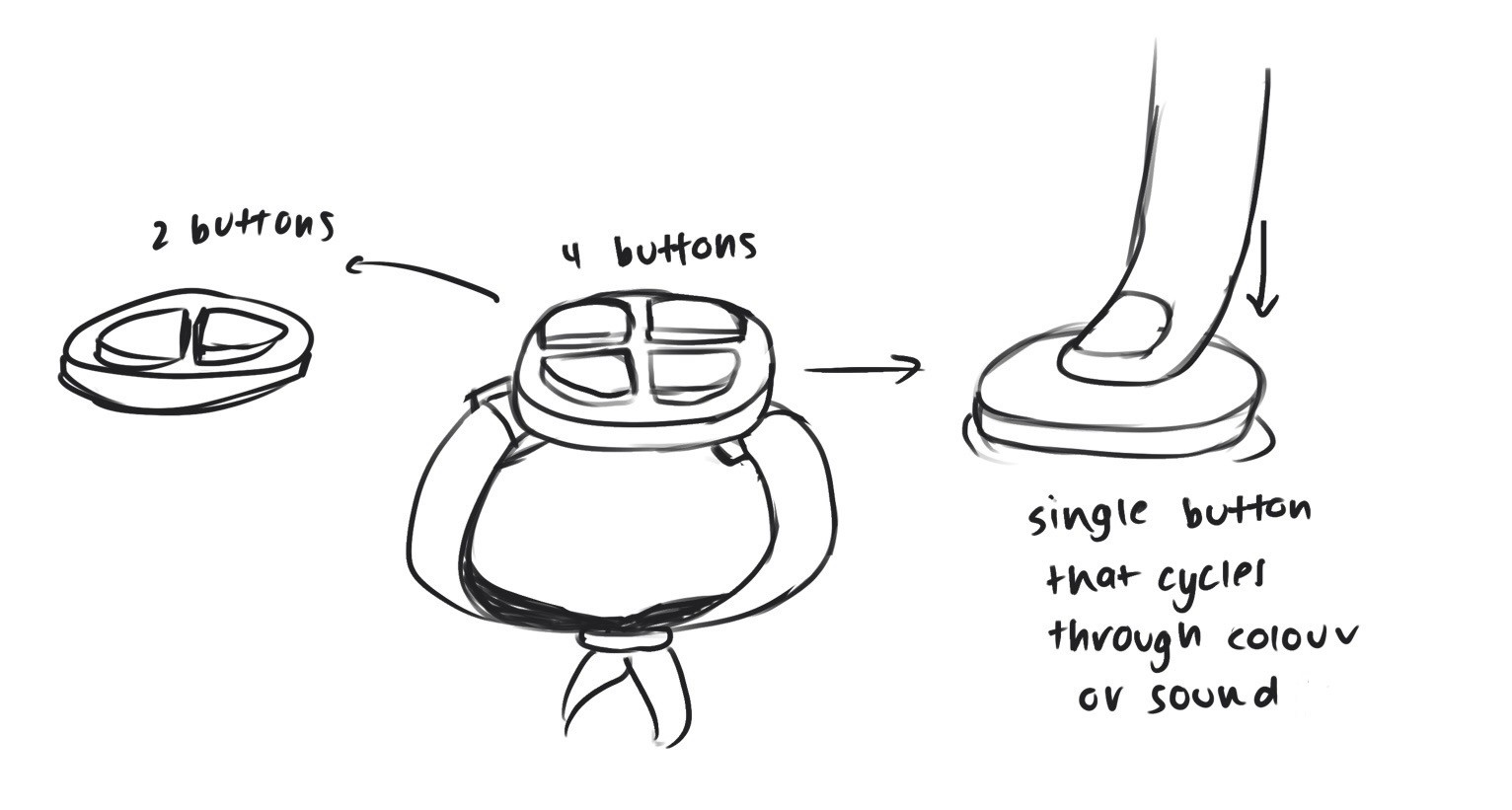
Sketches of the keepsake light band with buttons, inspired by the light bands from the Taylor Swift and Coldplay concerts. These are used to interact with the digital screens.
Barricades
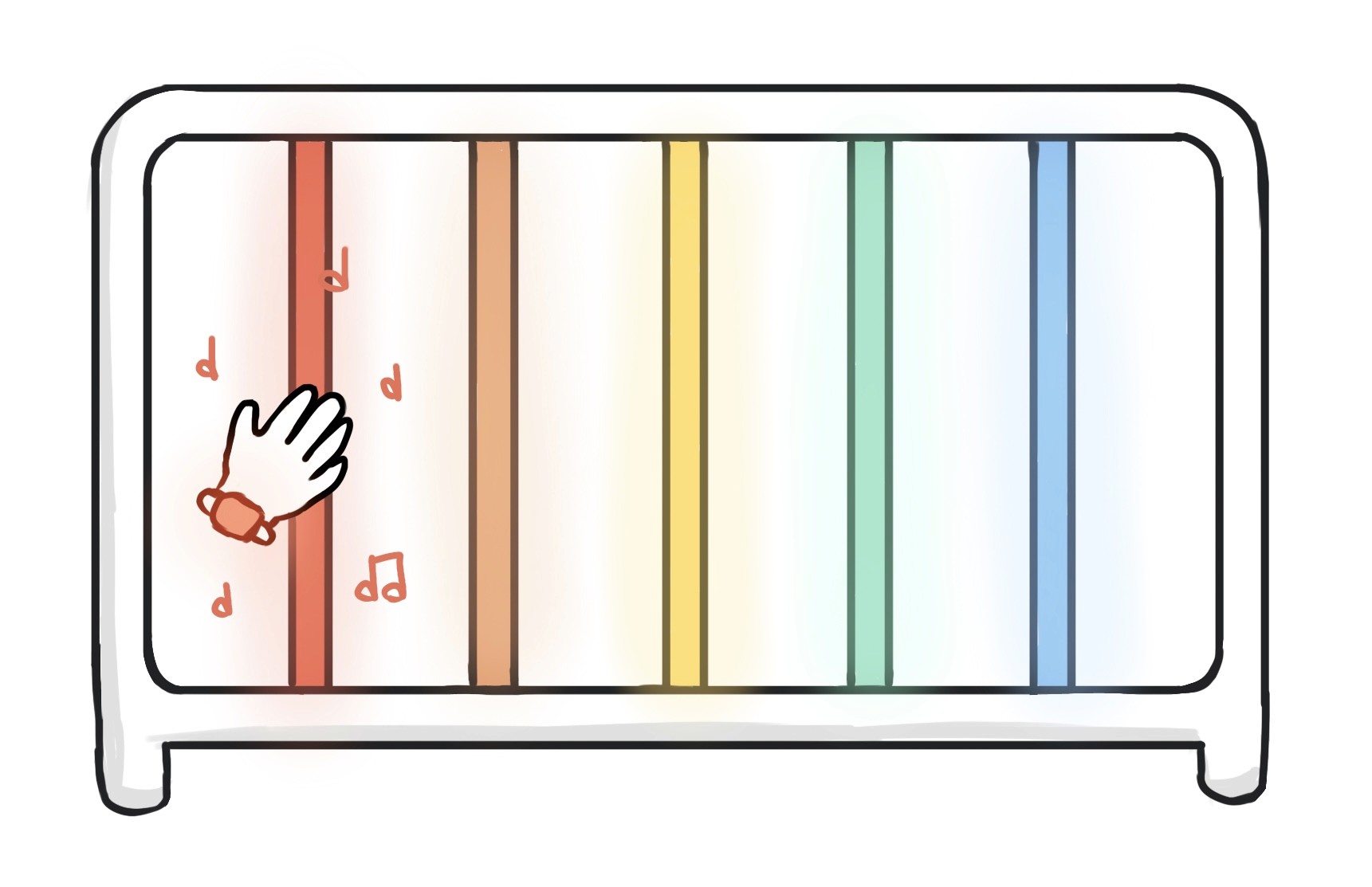
The poles are interact-able with touch, generating a sound from an instrumental layer of a song. When touched, the player's light band also lights up with the corresponding colour. Each player is assigned their own pole.
HIGH-FIDELITY (PHYSICAL PROTOTYPE)
Barricade
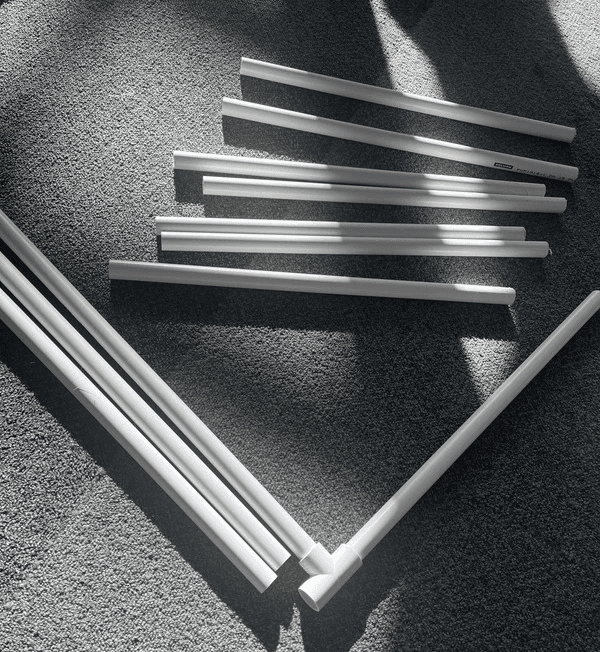
Instead of flimsy cardboard, we used a set of cut PVC pipes and connectors - a lot sturdier!
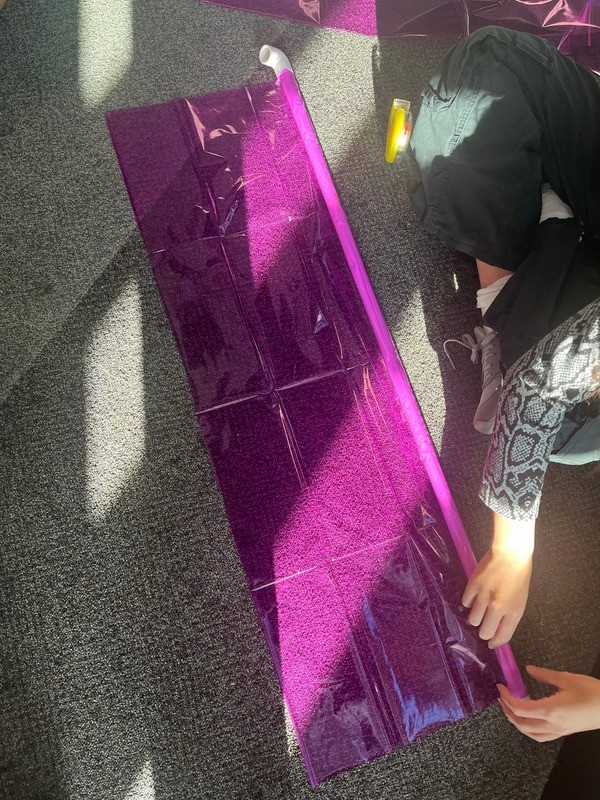
To mimic the light-up colours of Barricade DJ, we wrapped coloured cellophane around each pole.
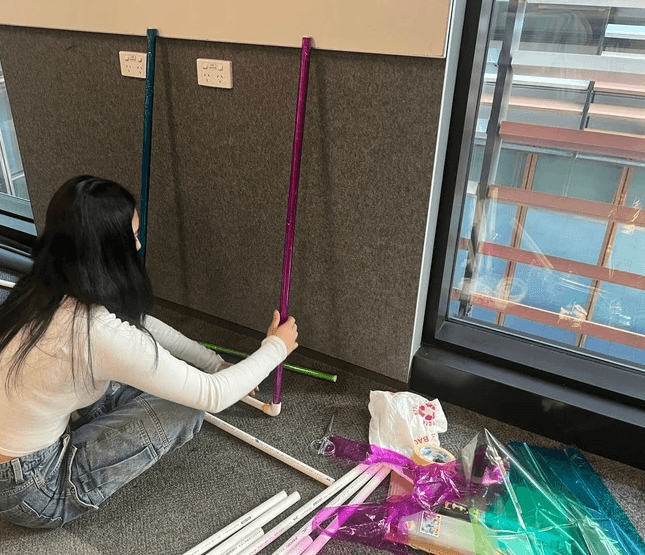
The PVC connectors helped to easily hold the frame in place!
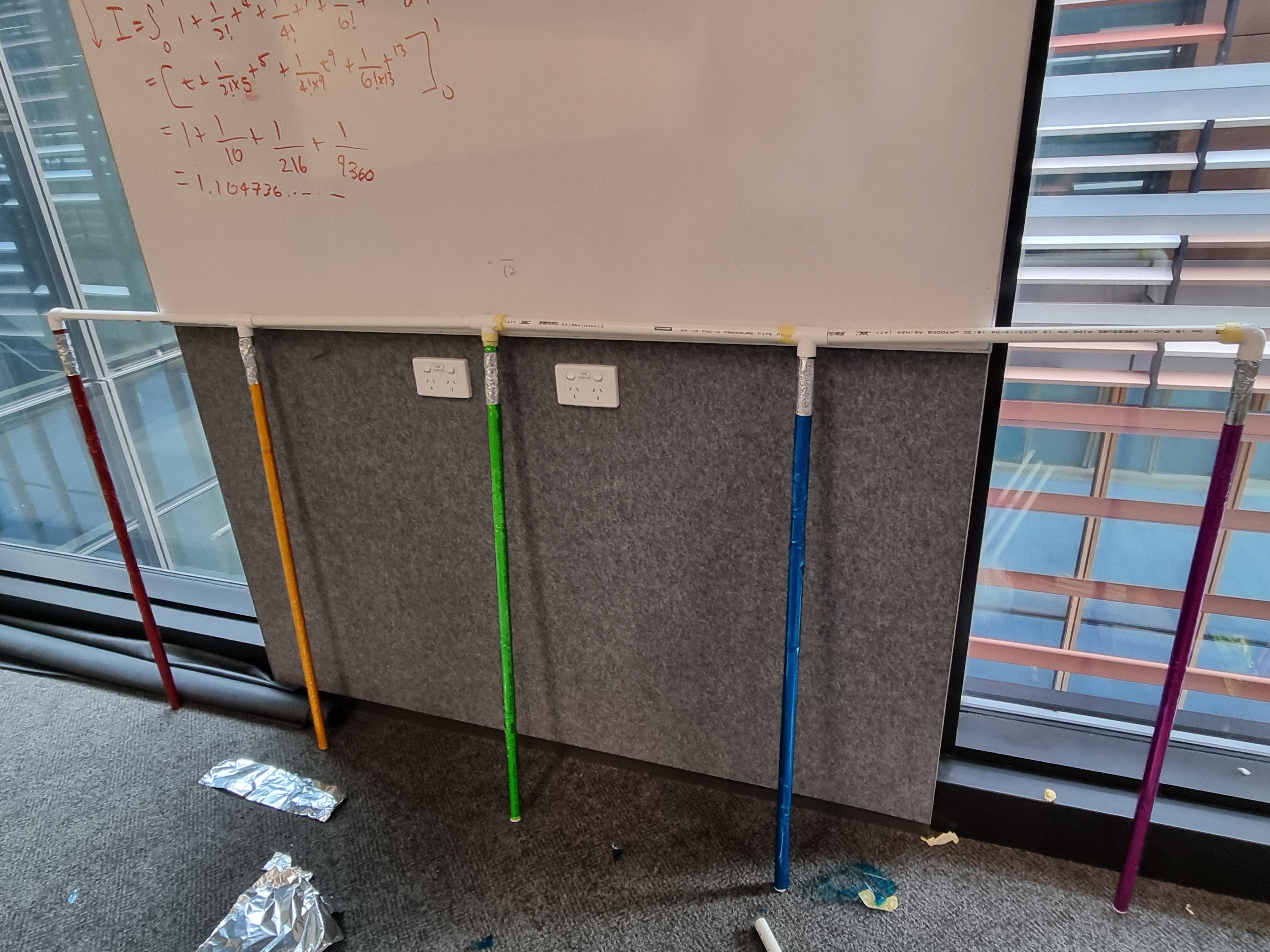
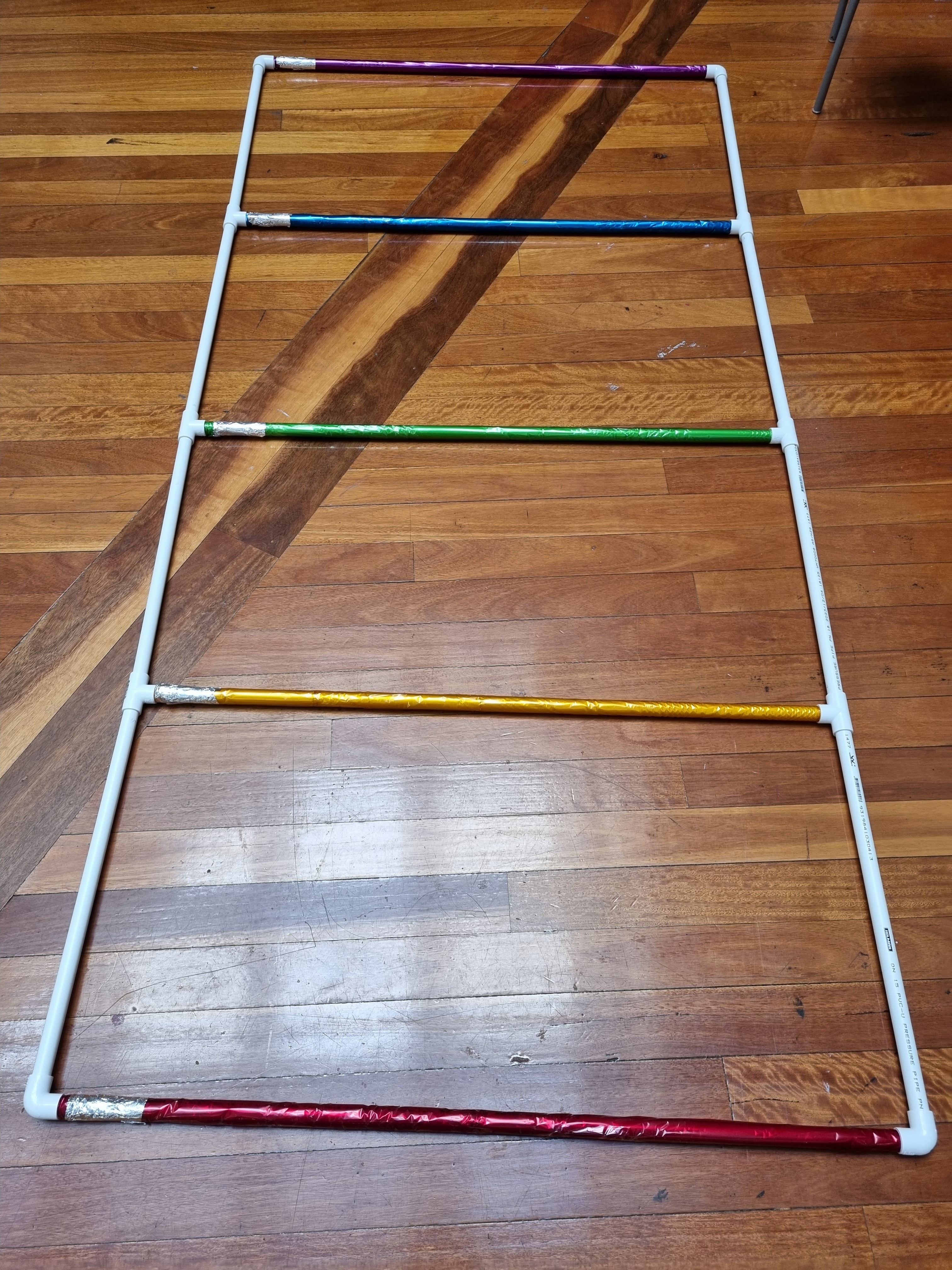
Everything put together!
Light Band
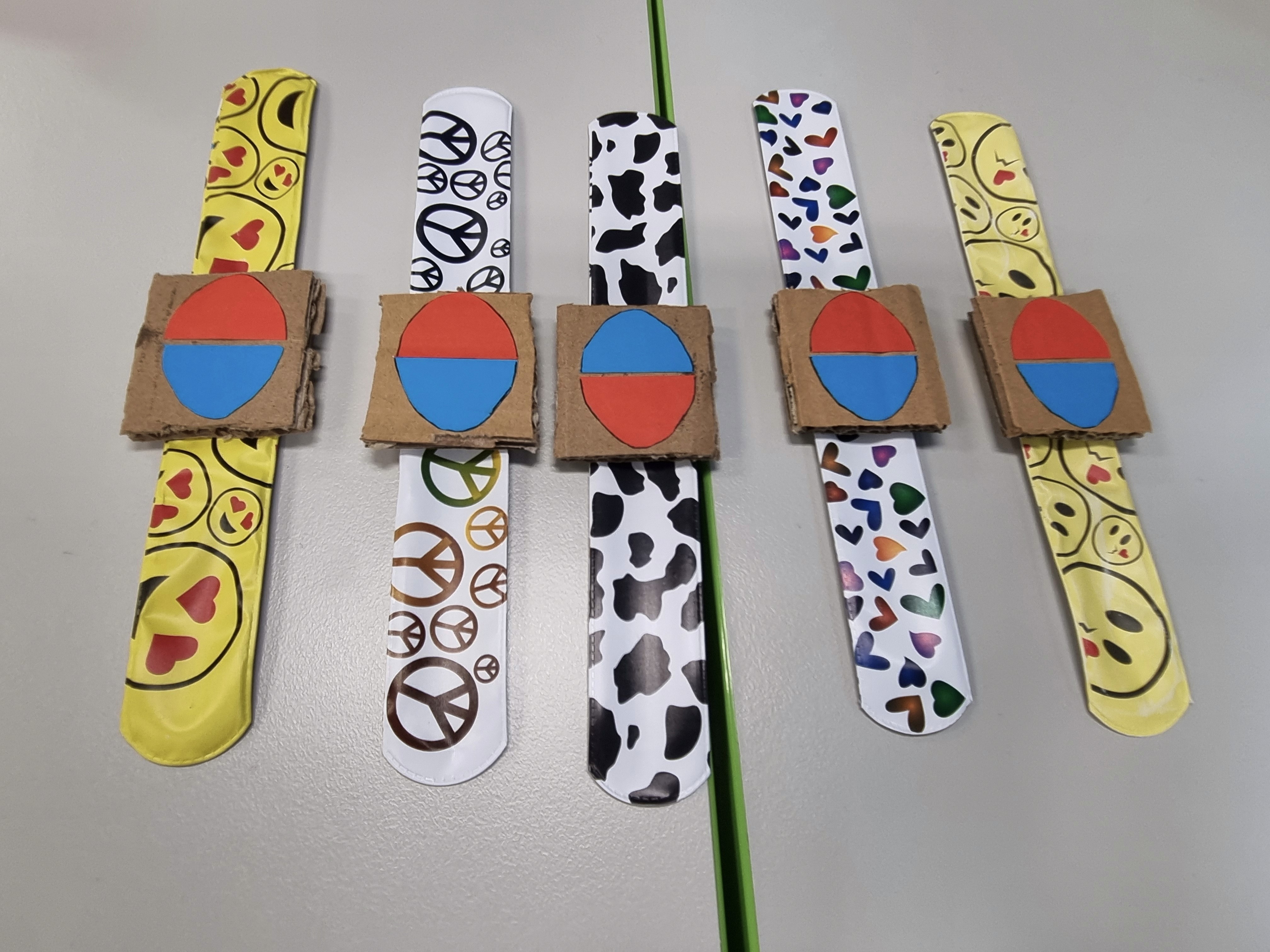
We created the light band prototype using slap-on wristbands and cardboard. We opted for a 2 button design for simplicity and to increase the chance of an outcome where majority rules.
Digital Screen (Song Voting)
We decided against our ambiguous prompts we initially had. Instead, voting over song titles:
Is more engaging and better at prompting socialisation - connecting fans through music
Builds anticipation as players have knowledge of the songs beforehand
Both of which enhance group synchronisation and teamwork!
Digitial Screen Prototype
Design Decisions
Onboarding UI with visuals
Learnability and retention during play sessions.
Progress bar
Affords more time for players to discuss votes
Makey Makey Magic!
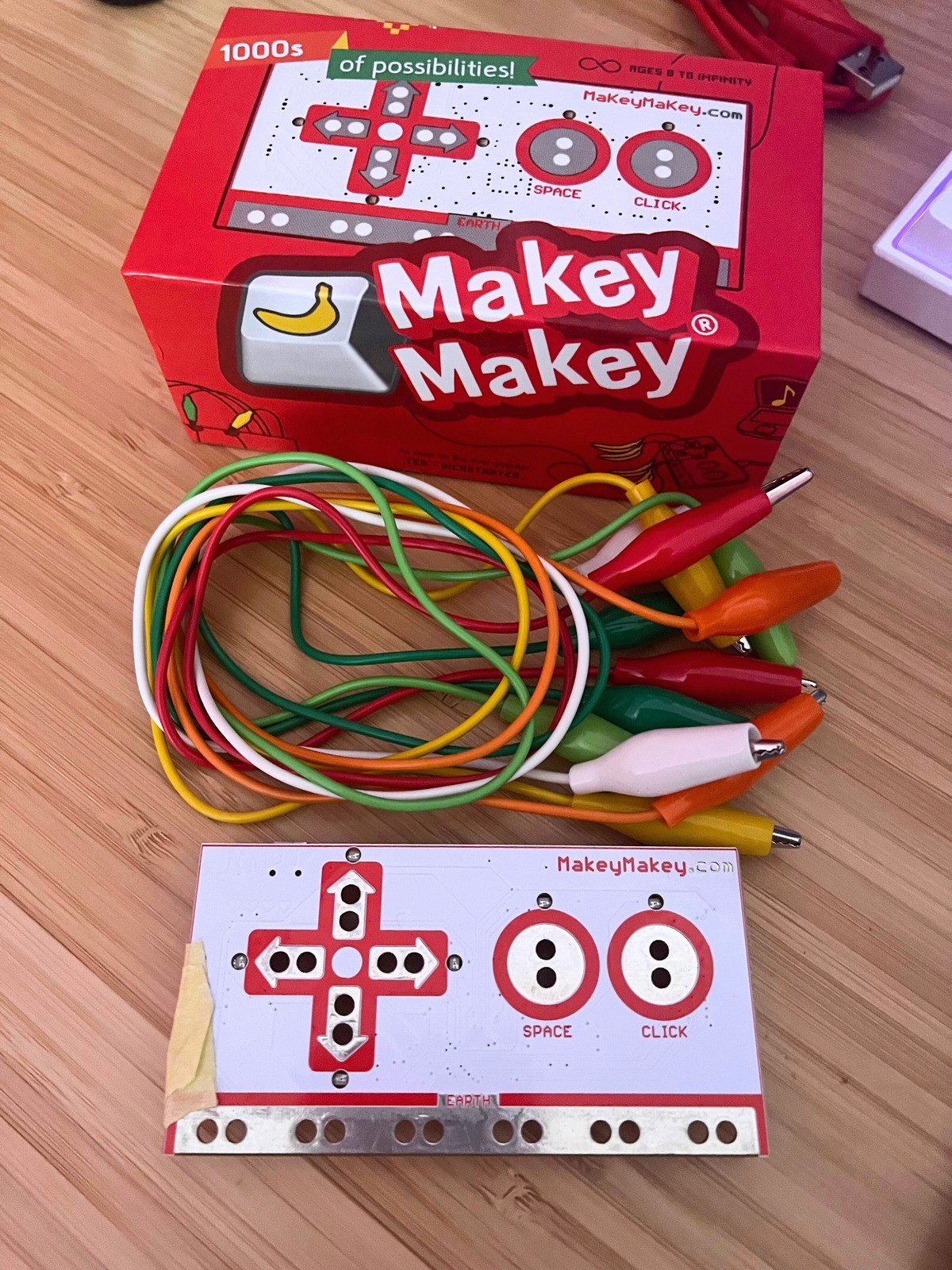
Our secret to simulating the interact-able poles was a controller kit called Makey Makey. Combined with lots of alligator-clip cables and aluminium foil connected to the poles and wristbands, we were able to produce snippets of sound. Makey Makey software allowed us to assign specific snippets to each pole.
USER TESTING
Testing Protocol
Testing sessions were conducted in groups of 2-5 participants, simulating an end use scenario.
THINK-ALOUD
SUS SURVEY
Quantifiable measure of ease of use and satisfaction.
POST-TEST INTERVIEW
Learn about user's difficulties and understanding of Barricade DJ's use-context.
Our Evaluation Objectives
Is the objective of the prototype clear and engaging?
Do users feel inclined to work with others to “play” the song?
Do users feel hyped or energised once they’ve played the song?
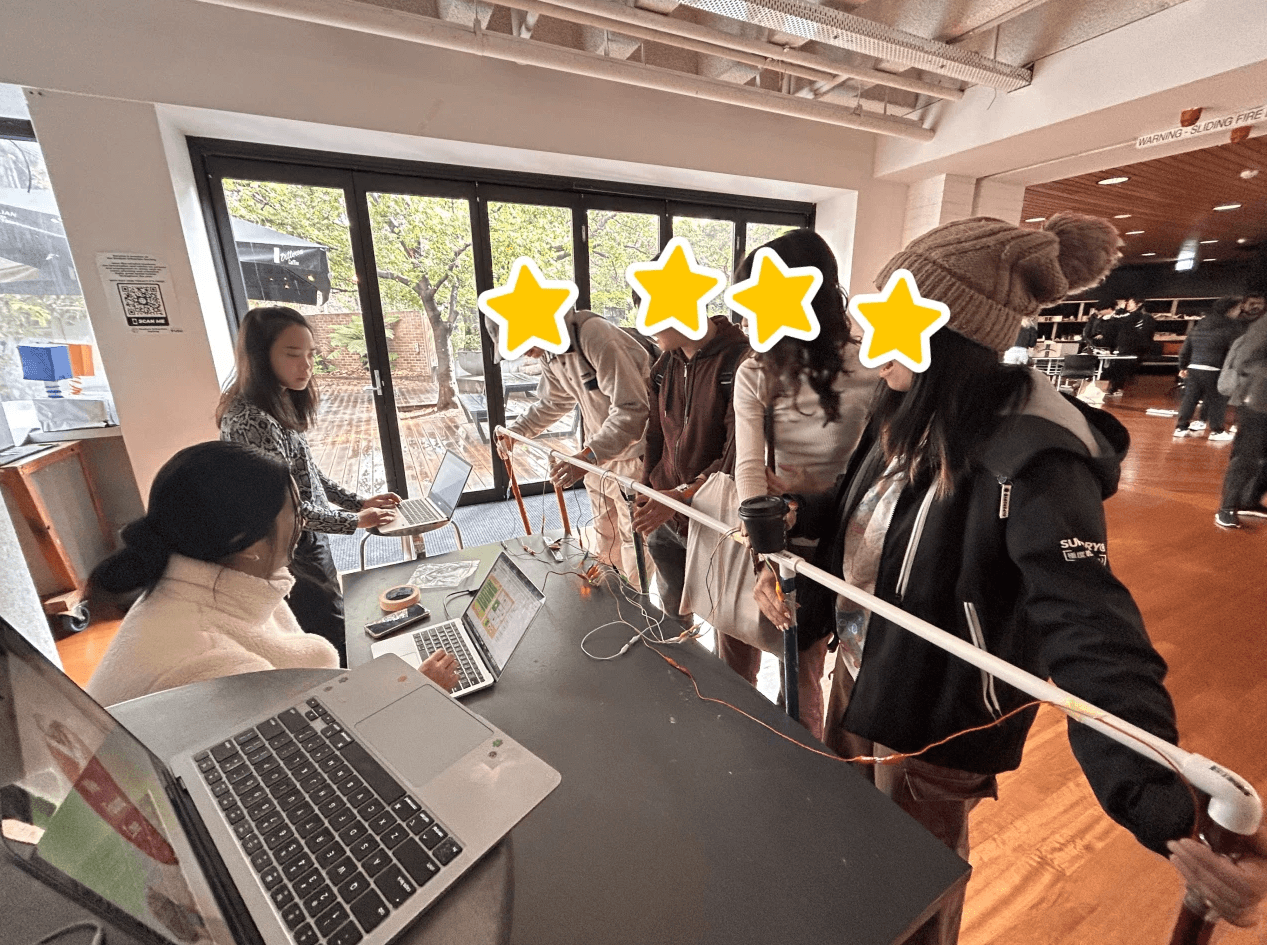
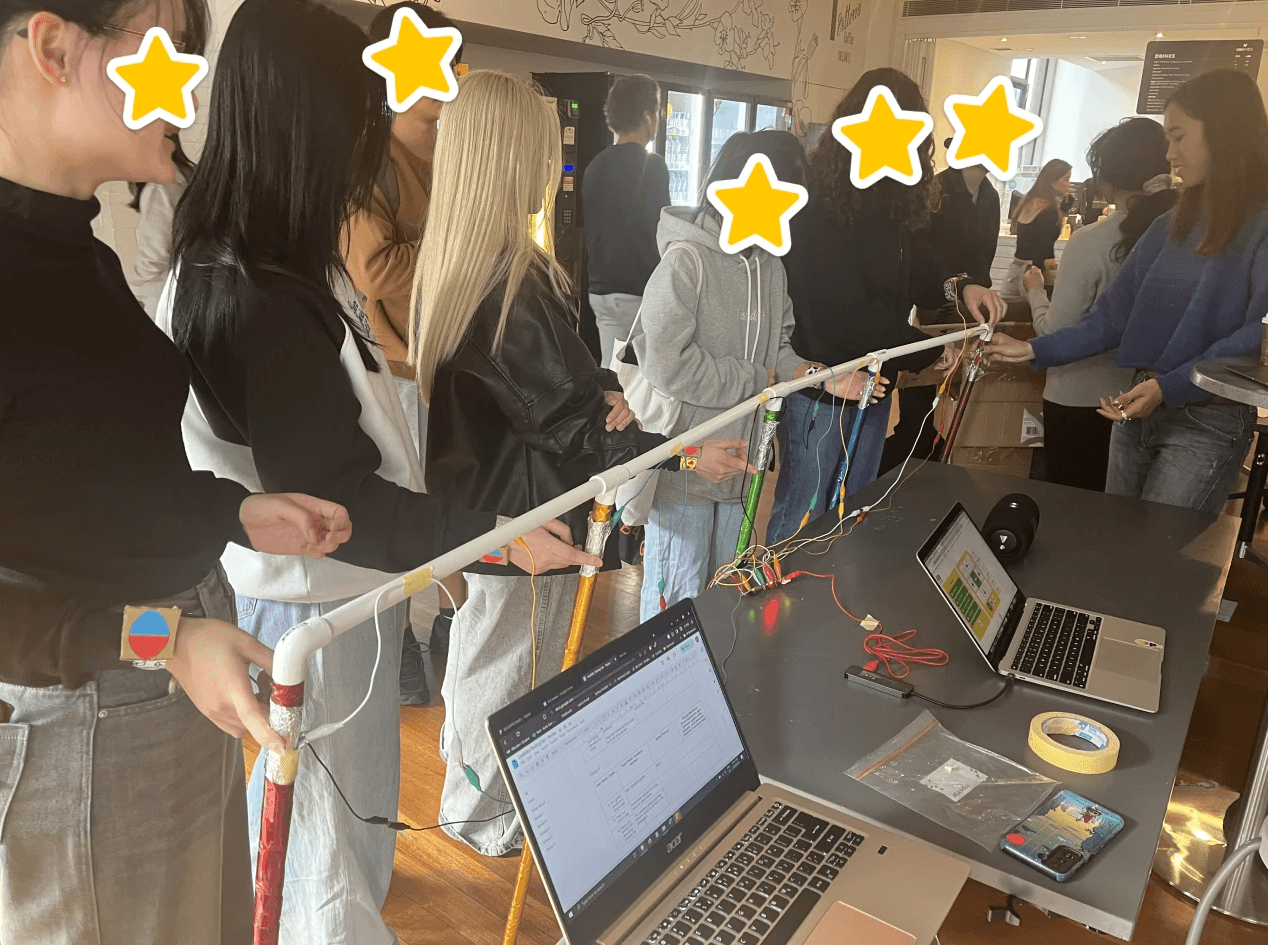
Our prototype in action!
Here are some key takeaways from our testing sessions:
HIGH-FIDELITY
Although a working high-fidelity prototype was not a part of the project roadmap, here are some iterations we planned to make:
In-active and active zones
Better integration with spatial elements and flow of the queue
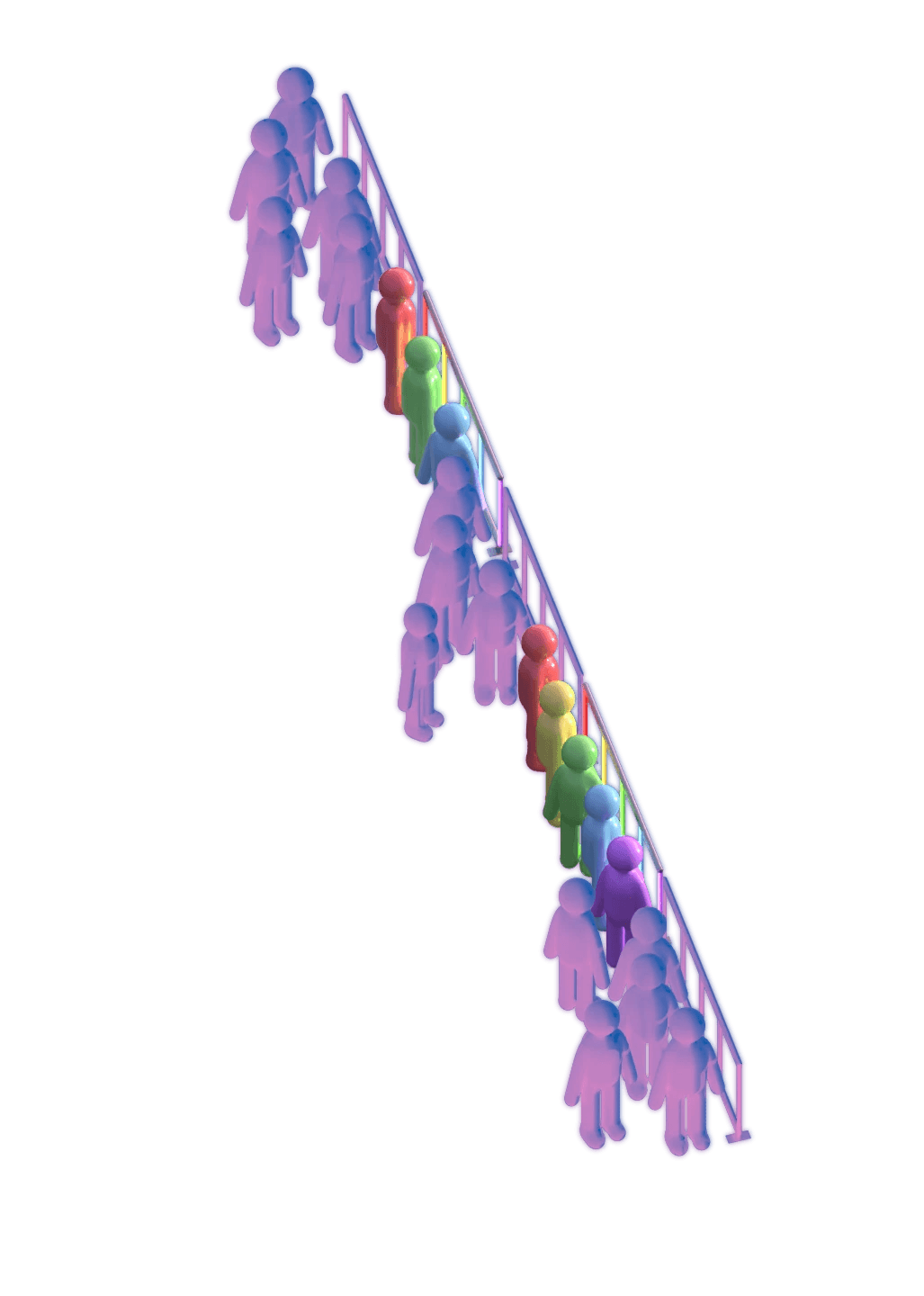
Our research revealed that how customers perceive their progress through a queue can be just as important as their actual progress. By alternating between in-active and active (play) zones, they are given a sense of progression and entertainment, subsequently building anticipation for their next turn to play. Breaks in inactive zones give time for concert-goers to mingle.
More clear contextual instructions in onboarding UI
Increased learnability, ease of use and overall enjoyment
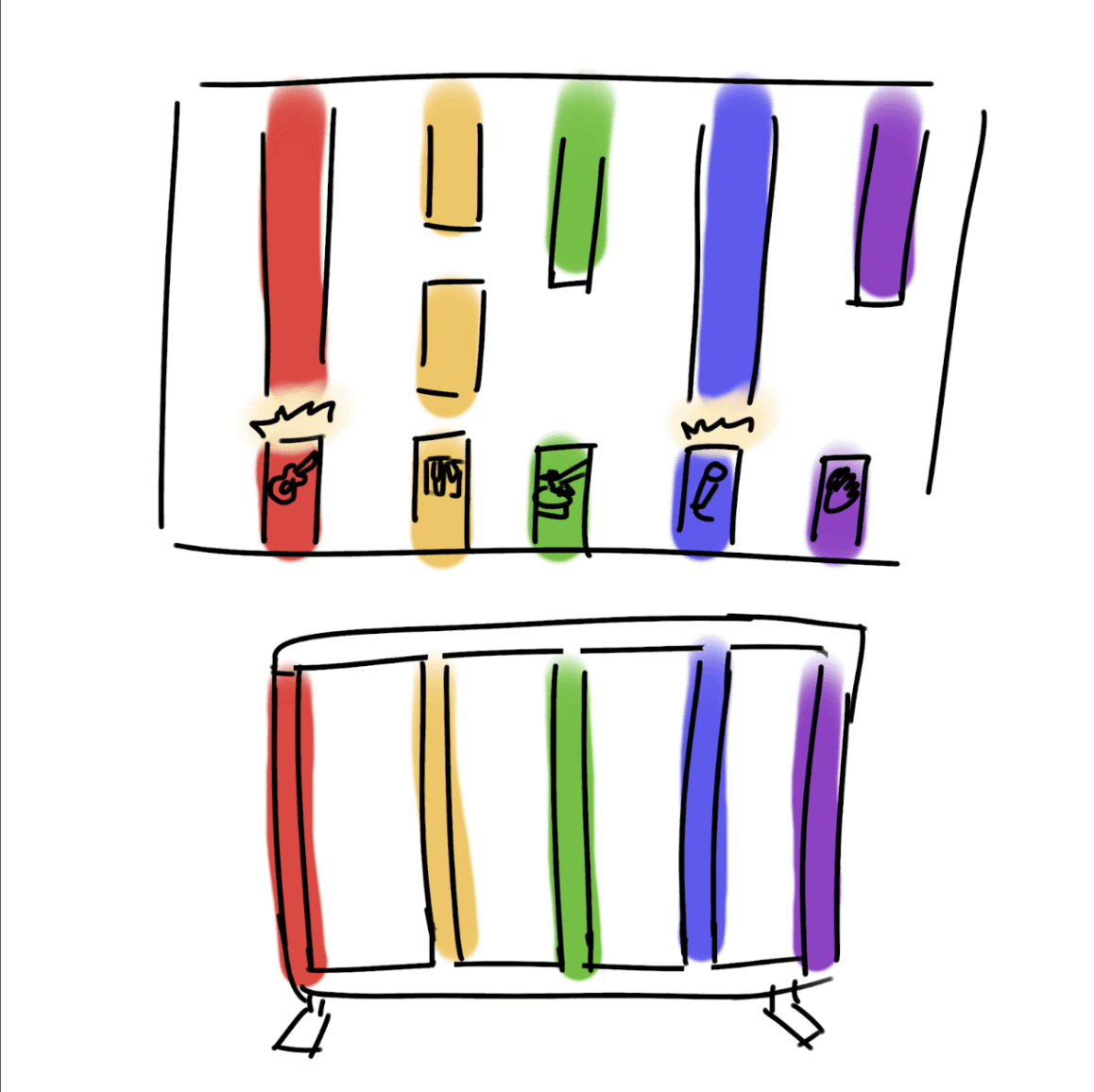
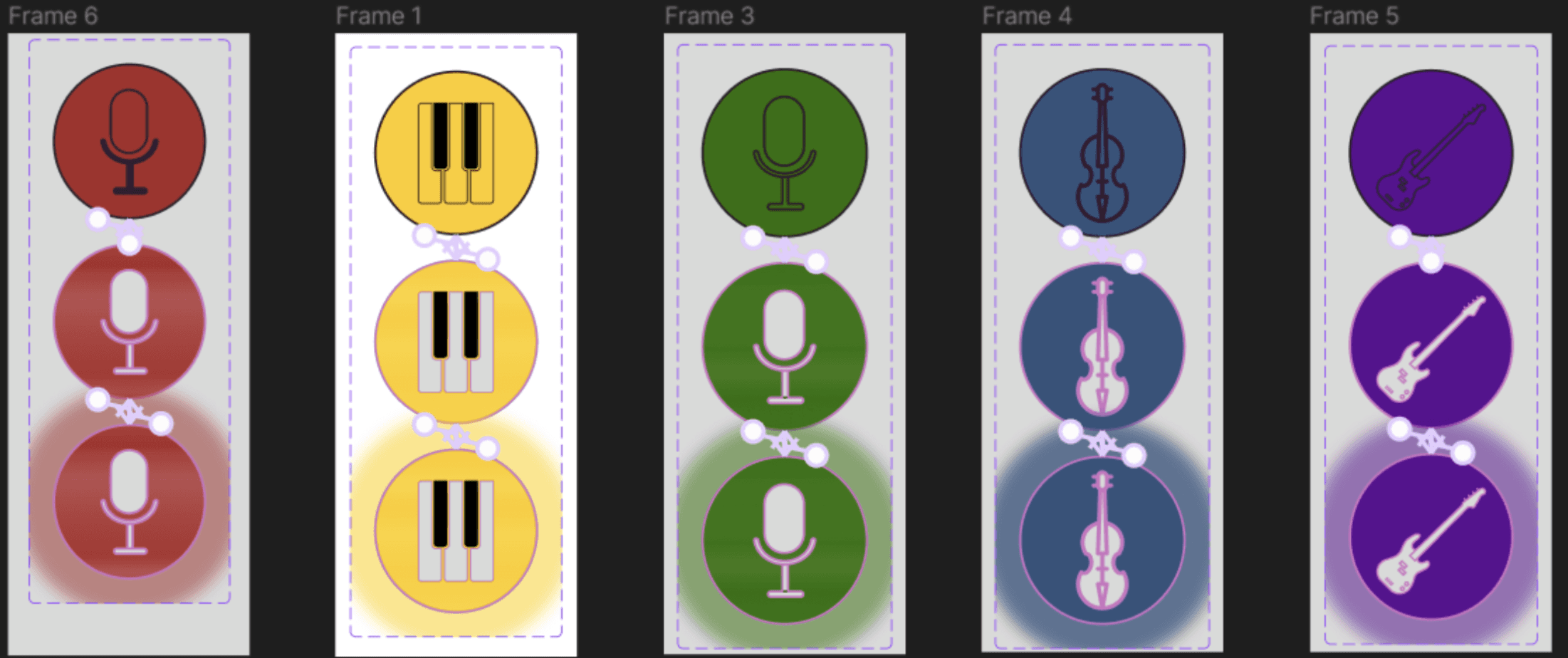
Precedent research of exisiting rhythm games helped us to design a UI system with visual cues that acts as a timing guide as users play. Each icon represents an instrument that when glowing and pulsating, indicates when to touch the pole.
Synced digital screens for all players, integrated in the environment
Allows for a more synced and unified playing experience
Our solution requires a complementary digital interface to display the UI, but we encountered difficulties envisioning its seamless integration into the environment. To address this, we had a look at outdoor digital billboards, kiosks and and mobile LED signs (like ones we observed at ACCOR Stadium) which can be strategically placed around venues.
Rather than having exclusive sessions in each play zone, we would make all the digital interfaces across the venue display the same UI flow, at the same time. This would also help to prevent sound issues between play zones, as it would now be synced.
final product
BRANDING + DESIGN SYSTEM
The Theme is… Retro!
We iterated on our previous UI design and opted for a retro aesthetic. We believed this was more fitting with the vibrant coloured poles, and the key aspect of Barricade DJ's experience - music.

Moodboard
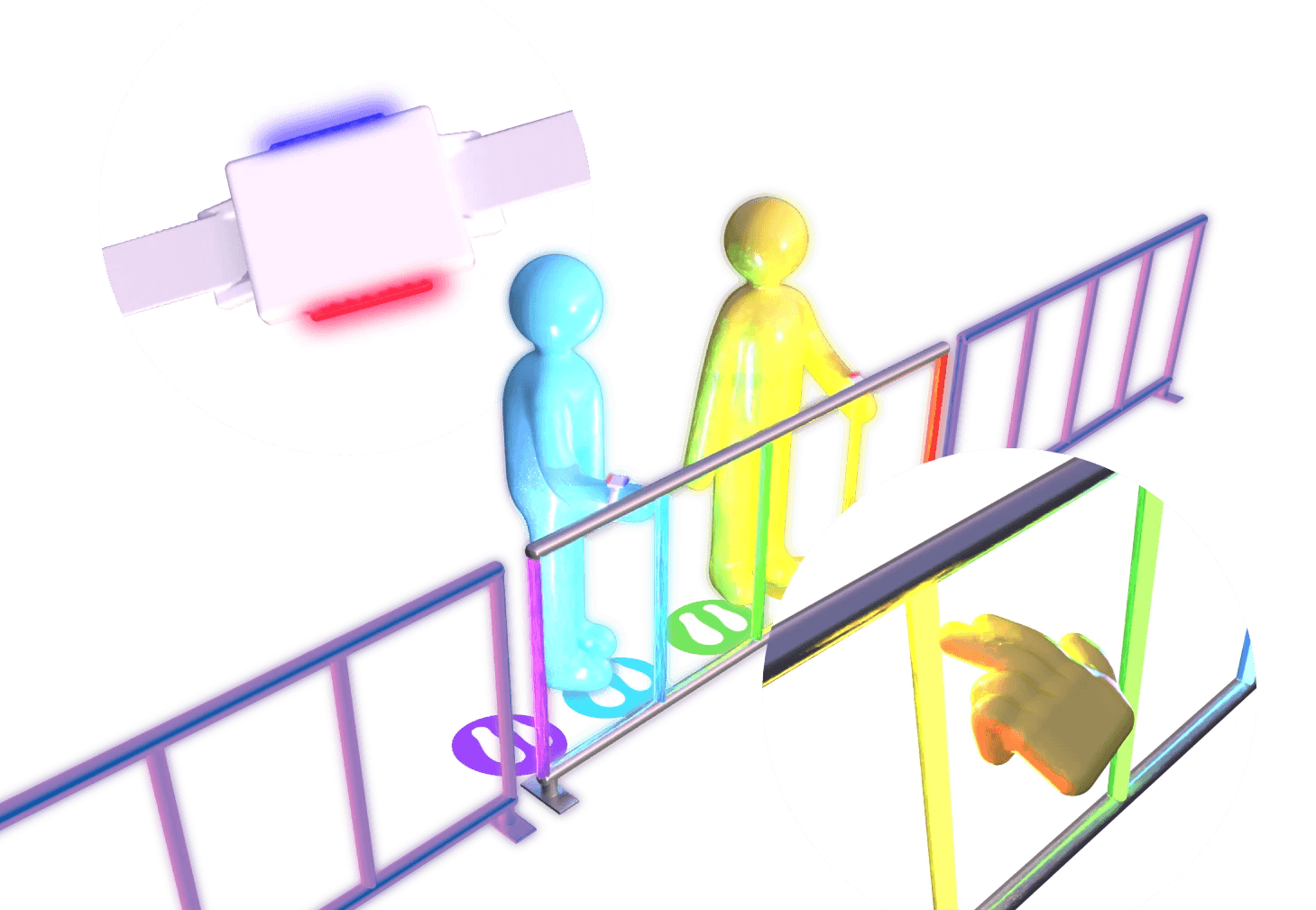
Some cool 3D assets I made on Womp!
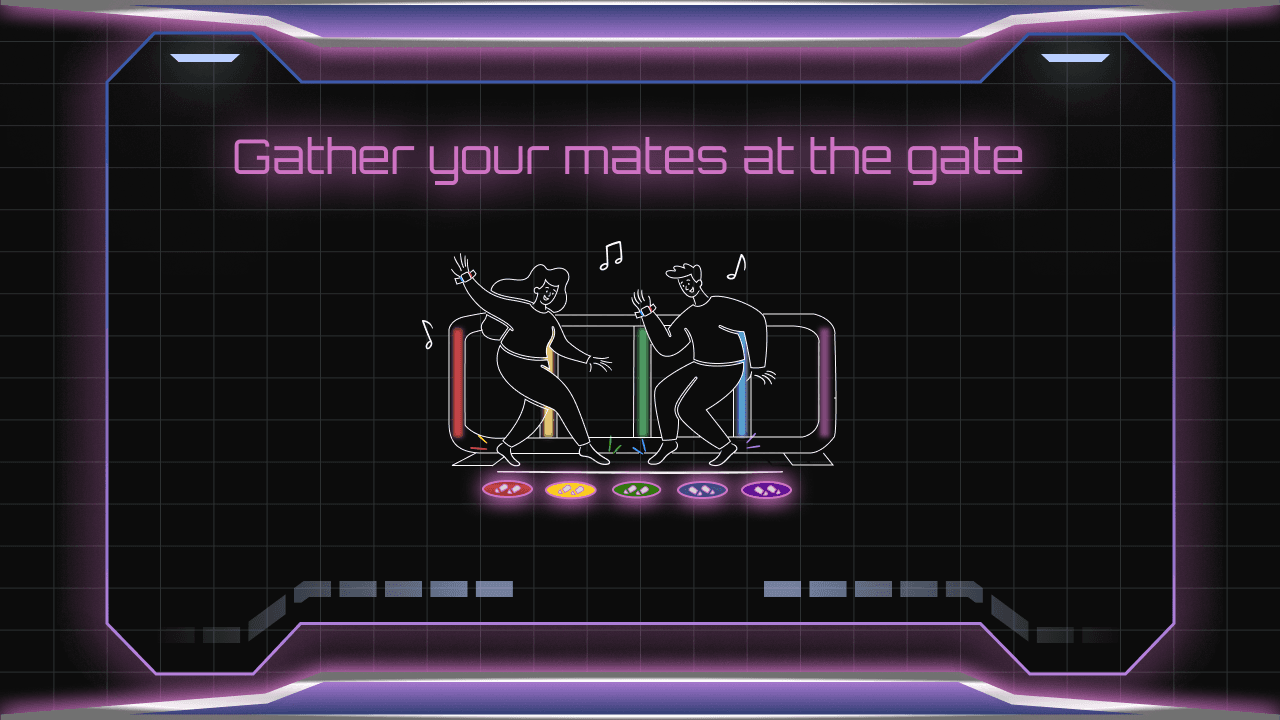
Iterated UI screens
LIMITATIONS
WHATS NEXT?
REFERENCES